MI・RX
Accelerating the development of lead-free piezoelectric materials through MI (Materials Informatics)
Narrowing down 1.26 million combinations to 550
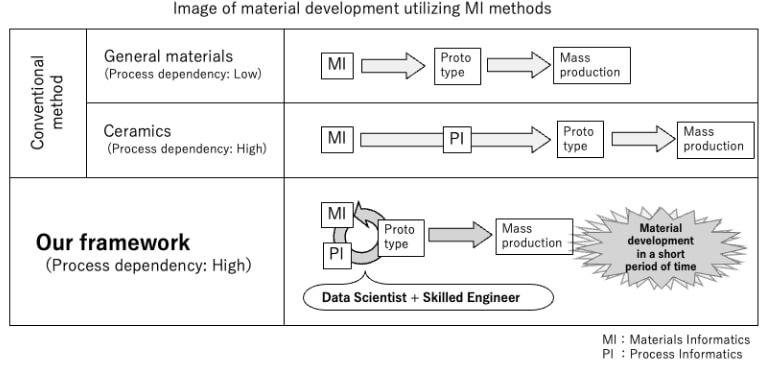
In the development of ceramics, overcoming "process dependency," where the manufacturing process directly affects product performance, was a major challenge. In particular, for the "alkali niobate-based" lead-free piezoelectric materials that we have been researching since around 2000, the number of combinations of composition and process conditions is enormous, requiring a vast development period using conventional methods. To solve this problem, rapid information sharing with data scientists allowed us to strictly select and narrow down what would normally be 1.26 million combinations to just 550. As a result, we succeeded in creating a new material in a short period of about six months.
Connecting on-site technology with data science
In addition to accelerating material development, we quantified the know-how possessed by skilled engineers on-site. By combining this with prototyping experiments in small-scale mass production equipment, we also succeeded in developing materials that facilitate a smooth transition to mass production in a short period.
<Characteristics of the newly developed material, etc.>
- ・Piezoelectric constant: d₃₃ = 400 pC/N
- ・Heat resistance: Curie temperature: Tc = 200℃
- ・Capable of mass production using the solid-state reaction method (a general ceramic synthesis method)
- ・No organic solvents used in the manufacturing process (reducing environmental impact)
- ・High reliability (environmental resistance, reproducibility)