



R&D Interview02
The new possibilities of silicon nitride,
discovered through trial and error.

Silicon Nitride Development by Niterra Materials
As EVs continue to operate at higher voltages and motor speeds, silicon nitride plays a crucial, albeit often overlooked, role in maintaining vehicle stability.
At Niterra Materials, we are leveraging our long-cultivated materials and mass production technologies to develop bearing balls and heat dissipation substrates. From a single, intricately crafted ball to a high-precision substrate, our developers have gone through years of trial and error. We spoke with Mr. Hyodo and Mr. Yuasa from the Development Technology Department about the role of materials, the challenges they have faced in development, and the future that technology is paving the way for.
Profile

Niterra Materials Co., Ltd.
Development & Engineering Dept. Engineering & Quality Assurance Group General ManagerHiroyuki Hyodo
He has been involved in the development of materials for electronic devices for many years. As the head of the Development Technology Department, he has been engaged in the development of fine ceramics (silicon nitride materials), metal products, and bonding technologies.

Niterra Materials Co., Ltd.
Fine Ceramic Development Section Development & Engineering Dept. Engineering & Quality Assurance Group SpecialistAkimasa Yuasa
Engaged in the development of fine ceramics (silicon nitride materials), etc. Responsible for a wide range of tasks, from material development to mass production startup.
*The information provided is current as of July 2026.
Organizational structure, names, etc., may differ from the current situation.
The increasing importance of silicon nitride due to the evolution of EVs
First, what role does silicon nitride play in electric vehicles (EVs)?
- Hyodo
-
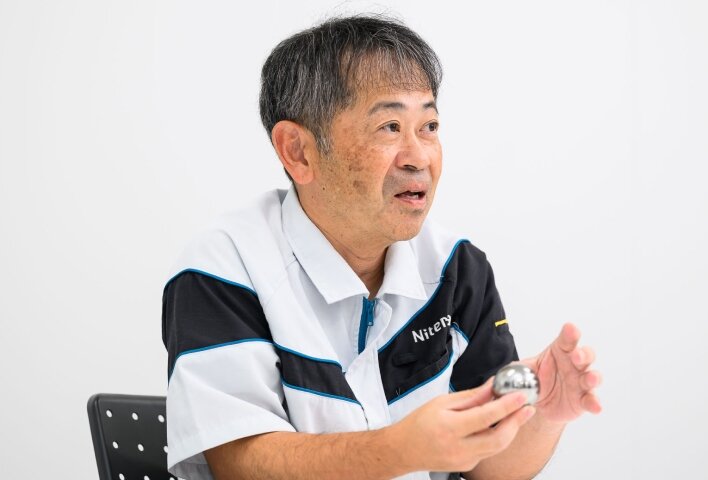
One of its most common applications is in bearing balls used in electric vehicle (EV) motors. EVs use inverters to control the motor, but this process can cause electricity to build up inside the bearings, leading to "electrolytic corrosion" where the metal surface is damaged by discharge. A major advantage of using silicon nitride balls, which do not conduct electricity, is that they suppress this discharge. Furthermore, the EV market is currently seeing increased voltage for faster charging and greater efficiency. Higher voltages make it easier for electricity to build up inside bearings, creating an environment where electrolytic corrosion is more likely. Additionally, silicon nitride, being lighter and stronger than iron, is essential for suppressing centrifugal force, heat generation, and wear associated with high-speed motor rotation. The demands of the times are creating an environment where the properties of silicon nitride are becoming even more valuable.
- Yuasa
-
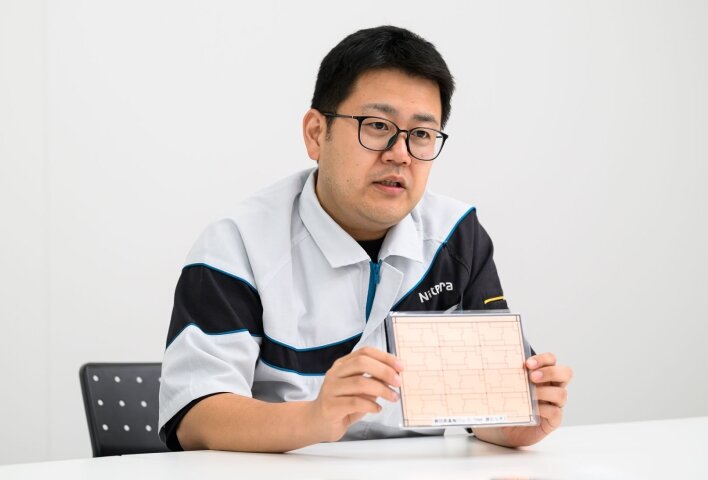
Another application is the heat dissipation substrate used in the power control unit (PCU) of EVs. The PCU is essentially the brain of the EV, controlling the power supplied to the motor in response to acceleration and deceleration. The semiconductor chips inside generate heat during operation, so it is necessary to dissipate the heat while insulating the electricity. In addition, automobiles are exposed to vibrations and large temperature changes. Silicon nitride is a material that can achieve a high level of balance between insulation, thermal conductivity, and mechanical strength.
- Hyodo
-
Copper is bonded to the substrate, but metals and ceramics expand differently due to heat. Repeated temperature changes put significant stress on the joint, so strength to prevent cracking is essential. Even with the same silicon nitride, the properties that customers prioritize differ. We leverage our years of accumulated knowledge in materials development to create materials with properties tailored to each application.
Not a single flaw will be overlooked. Years of trial and error.
What challenges did you encounter in developing the new bearing balls?
- Yuasa
-
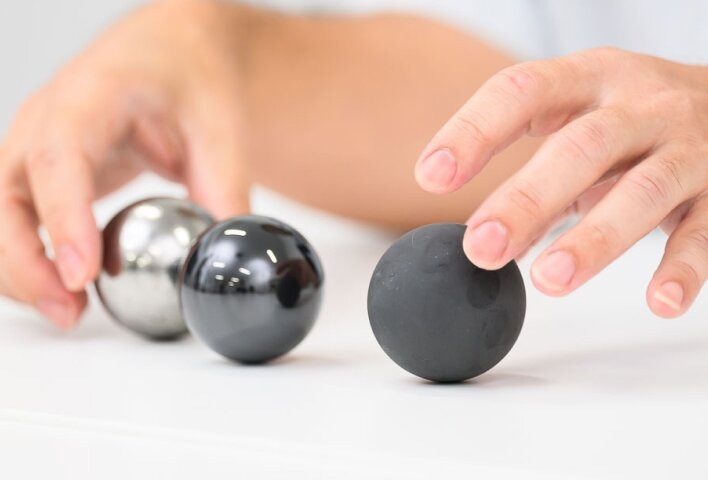
The value of silicon nitride balls lies in their robustness. However, even tiny holes on the surface or inside can cause chipping or breakage. In the development of new bearing balls, we initially encountered problems such as surface peeling and the appearance of holes, which prevented us from meeting customer requirements. Changing the material composition alters the previously optimal manufacturing conditions. Simply creating the material is not enough to produce a finished product; the entire mass production process needed to be re-evaluated.
Specifically, how did you investigate the cause?
- Yuasa
-
We reviewed each step of the manufacturing process. The most challenging part was the raw material process at the very beginning. We discovered that small clumps formed when the raw materials were mixed remained in subsequent processes, eventually detaching from the surface of the ball and creating holes. Therefore, we meticulously adjusted the process conditions and additive ratios to minimize the formation of these small clumps. This issue alone took about five months, and tuning the entire process took about a year. If we include the preliminary consideration of material formulations, the development process spans several years.
- Hyodo
-
The combinations of material formulations are endless once you start thinking about them. If you get the starting point wrong, development will take even longer. This is where the knowledge we have accumulated so far comes in handy when narrowing down the candidates. Based on past data and experience, we determine "this direction has potential" and then refine the conditions while incorporating statistical analysis.
- Yuasa
-
There were times when, no matter how many times we tried, we couldn't get the results we wanted. Even so, we continued to check each phenomenon one by one, and with the cooperation of the manufacturing department and others around us, we kept adjusting the conditions. The ball in front of us may look simple, but it is filled with trial and error in eliminating defects from both the material and process sides. When we were able to successfully launch the new product, I felt that all the hard work we had put in had finally taken shape.
Accumulating material development and mass production technologies for future growth
What do you think are Niterra Materials' unique strengths?
- Hyodo
-
Our company commercialized silicon nitride balls in 1985 and heat dissipation substrates in 1996. In the past, our silicon nitride balls were even used in the Space Shuttle, where the highest level of reliability was required. Our strength lies in our long-standing relationship with silicon nitride, accumulating not only material development but also the technology for stable mass production. The required performance differs depending on the application: some require the highest level of reliability, while others need to balance performance and cost. It is our years of accumulated experience that allows us to discern the right direction from countless materials and conditions, and to develop materials that meet our customers' requirements.
- Yuasa
-
We first refined our technology to leverage the strength of silicon nitride, and then expanded its potential by adding thermal conductivity and electrical properties. Rather than taking leaps, we solve one problem at a time and apply that knowledge to the next product. I believe this steady evolution is our strength.
What kind of future do you hope to support with silicon nitride technology?
- Hyodo
-
Silicon nitride is a very promising material that possesses multiple excellent properties. Currently, we envision using it to support the EV market in bearing balls and heat dissipation substrates, but we would like to expand its possibilities to specialized applications such as space in the future. We believe that continuing to address our customers' evolving needs and developing materials that meet their requirements with our technology will contribute to the growth of the Niterra Group.
- Yuasa
-
I want to realize a future where the products I develop are one day installed in actual cars and contribute to society. The technology may not be easily visible in the product itself, but that's precisely why I want to continue creating materials that people can use with confidence, without compromising on any single condition.