
90th anniversary

Management Plan

The automotive industry, which Niterra has grown alongside since our origins as the Morimura Group's sparkplug division, is undergoing a profound transformation toward electrification. This new era demands that we also fundamentally reform. Our Mid-term Management Plan outlines the key pillars for this transformation.
​

​

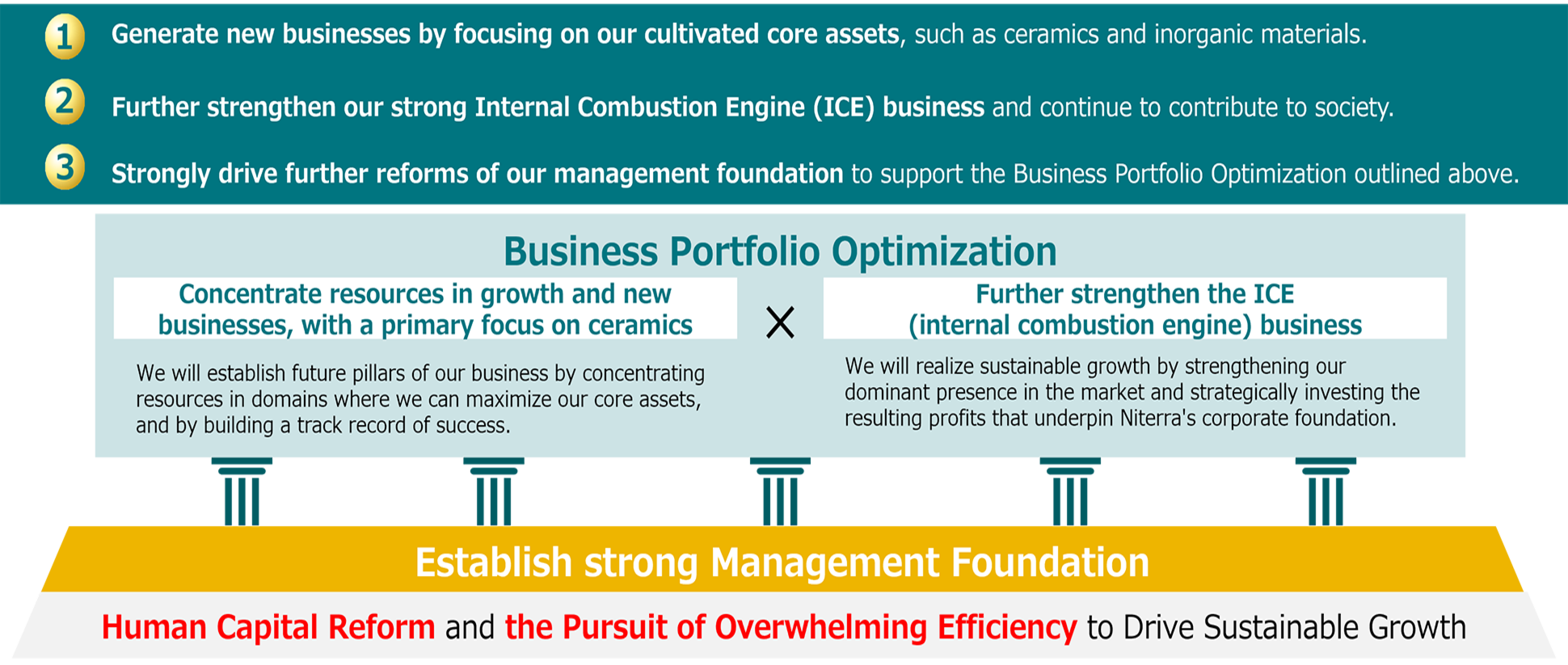
The three pillars of our medium-term management plan are: 1. We will focus on our core assets, such as ceramics and inorganic materials, which we have cultivated to date, and create new businesses. 2. We will further strengthen our robust internal combustion engine business and make a social contribution. 3. We will strongly promote further reforms to our management foundation to support the optimization of our business portfolio as described above. The optimization of our business portfolio will be achieved by combining "growth centered on ceramics and concentration of resources on new businesses" with "further strengthening of the internal combustion engine business," supported by the construction of a strong management foundation through human capital reform and the pursuit of overwhelming efficiency.

Mid-term Management Plan 2030(April 2025 -March 2030)

The Mid-term Management Plan 2030 is positioned as the final step toward the 2040 Vision.

We will expand priority areas by leveraging our ceramic technologies, building on profit growth in the internal combustion engine (ICE) business.
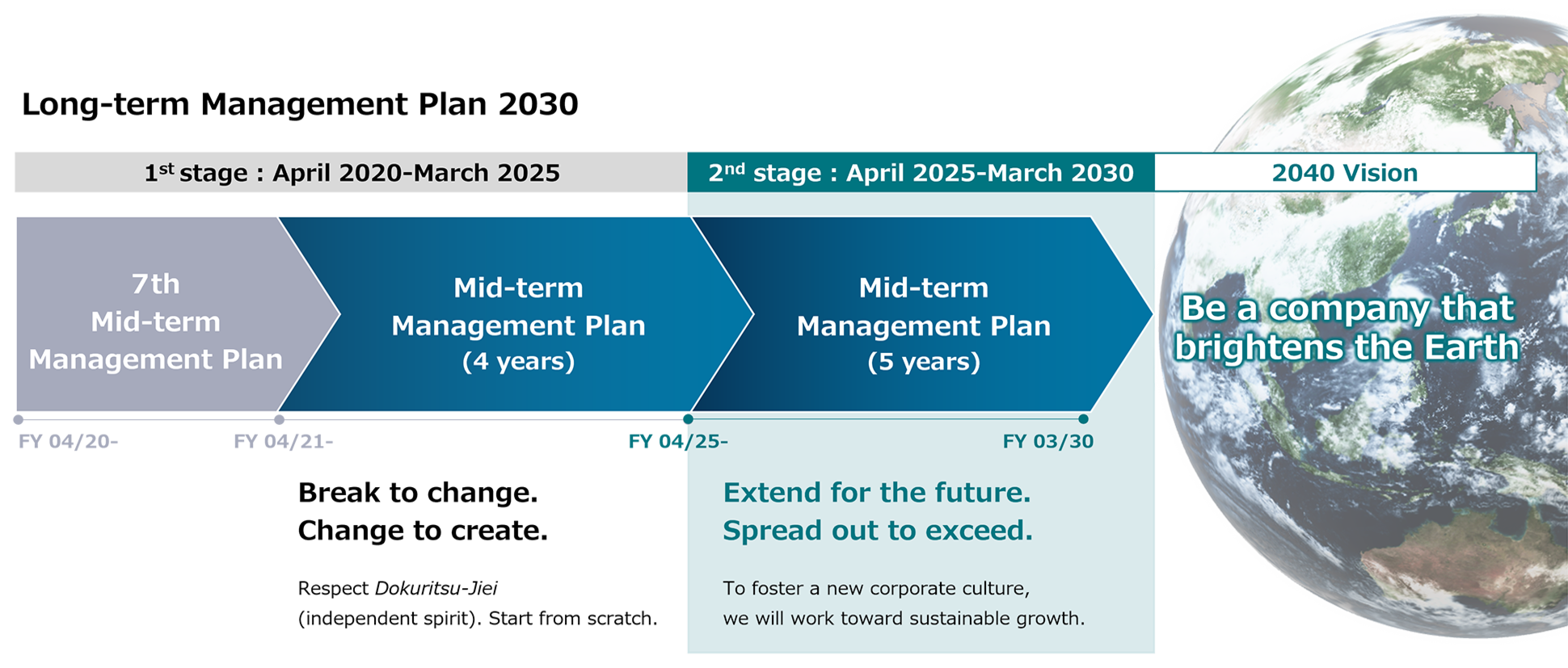
The Long-Term Management Plan 2030. Following the 7th Medium-Term Management Plan (April 2020-), the Medium-Term Management Plan 2025 (4 years, April 2021-March 2025), and the Medium-Term Management Plan 2030 (5 years, April 2025-March 2030), the company aims to become its ideal state in 2040: "A company that makes the Earth shine."

Focus Areas

Narrow down our focus areas for solving social issues and concentrate management resources in "Mobility," "Semiconductors," and "Environment & Energy," where our core assets can be maximized.

Medical business: not defined as a primary focus domain, but rather as a business initiative that utilizes our core assets.
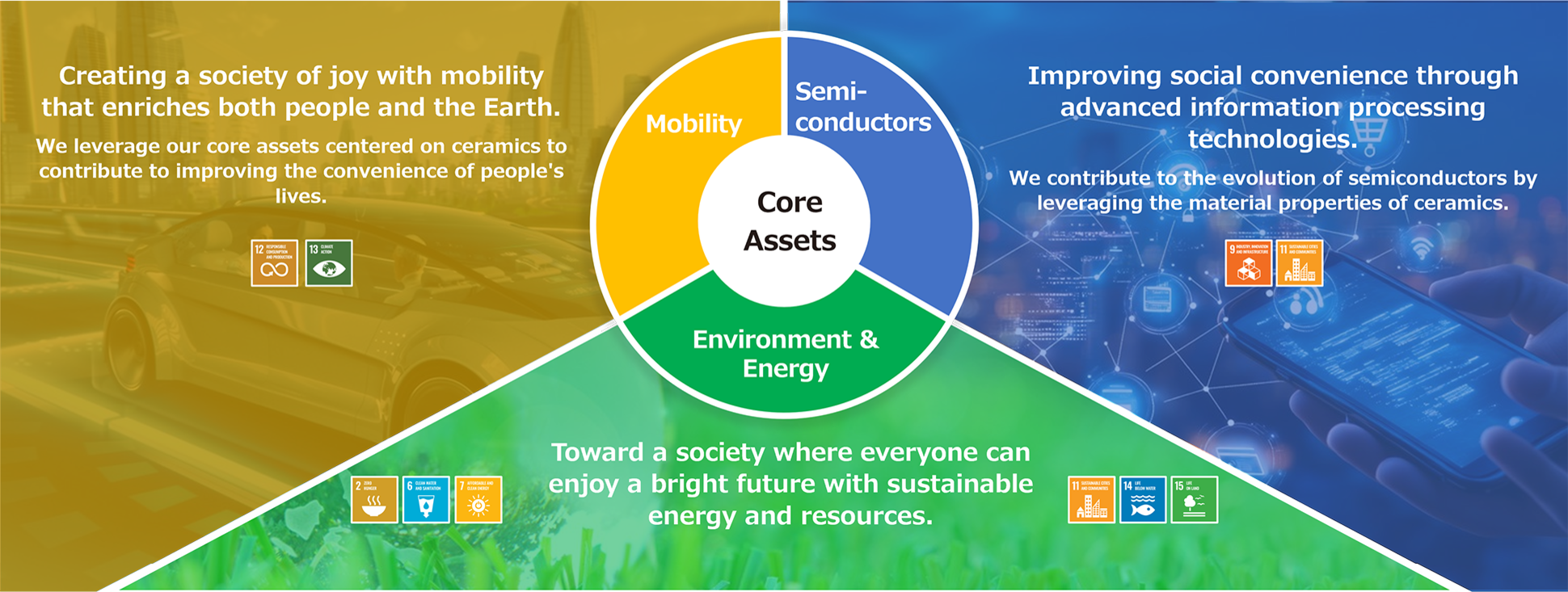
Three focus domains centered around core assets: Mobility ("A joyful society through enriching mobility for both the planet and people"), Semiconductors ("Improving the convenience of society through advanced information processing technology"), and Environment & Energy ("A society where everyone can enjoy a bright future through sustainable energy and resources").

Initiatives to enhance corporate value

To enhance corporate value, we will pursue the dual drivers of further improving both ROE and PER.
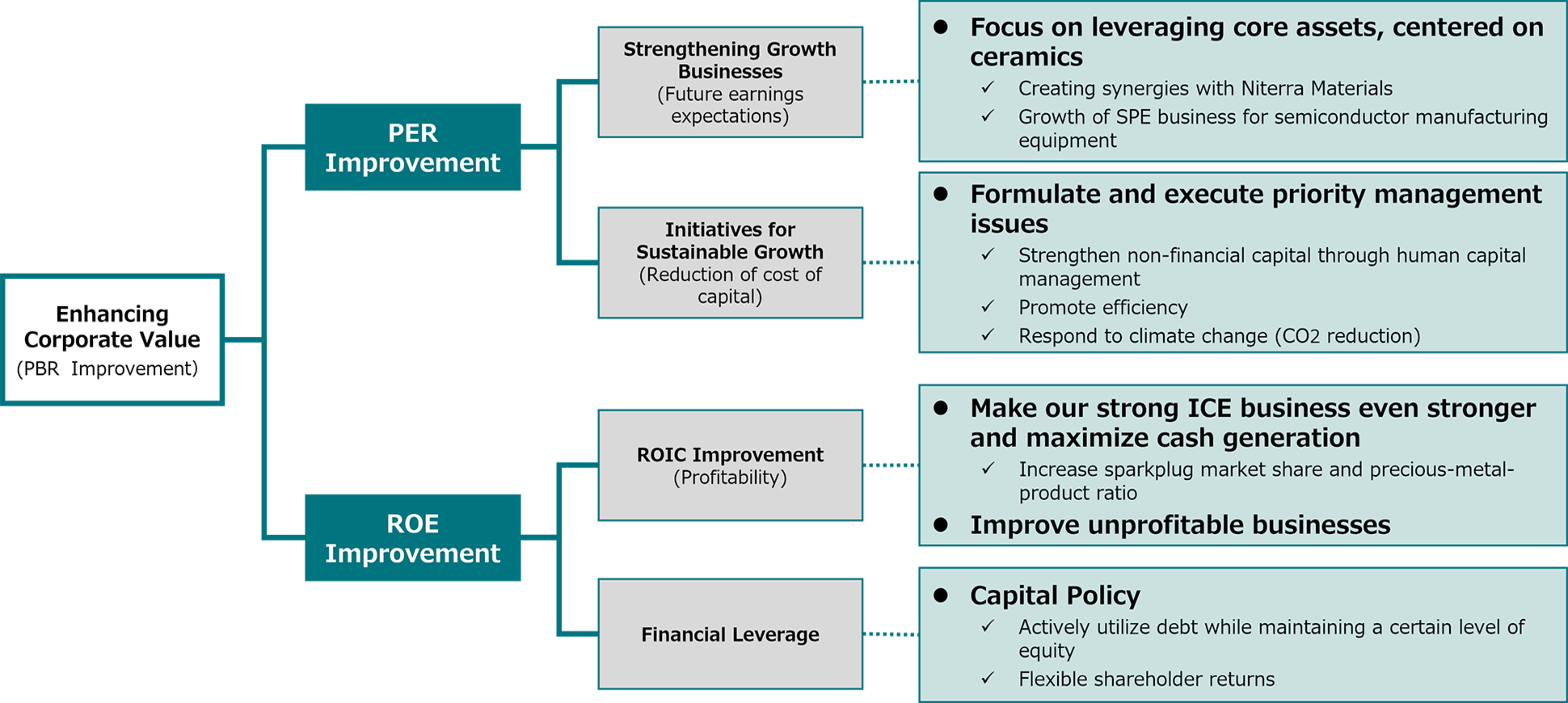
The components of improving corporate value (improving PBR). Improving PER is achieved through strengthening growth businesses (expectations of future earnings) and initiatives toward sustainable growth (reducing the cost of capital), while improving ROE is achieved through improving ROIC (profitability) and financial leverage.

Key Management Targets

With regard to revenue, we will focus on our ceramics-based domains, and considering the anticipated continued existence of the ICE market, we aim to greatly expand our top line, targeting a 1.5x increase to 1 trillion yen between the fiscal year ended March 2025 and the fiscal year ending March 2030.

Furthermore, our policy is to enhance our earning power through growth investments centered on the Automotive Components*1 and SPE businesses, expanding EBITDA to 285 billion yen, which corresponds to a 1.6x increase.

* This management target includes the plug and exhaust sensor businesses, for which a business transfer agreement was concluded with DENSO in September 2025. Although clearance from competition authorities has yet to be obtained, these businesses are included under certain assumptions.
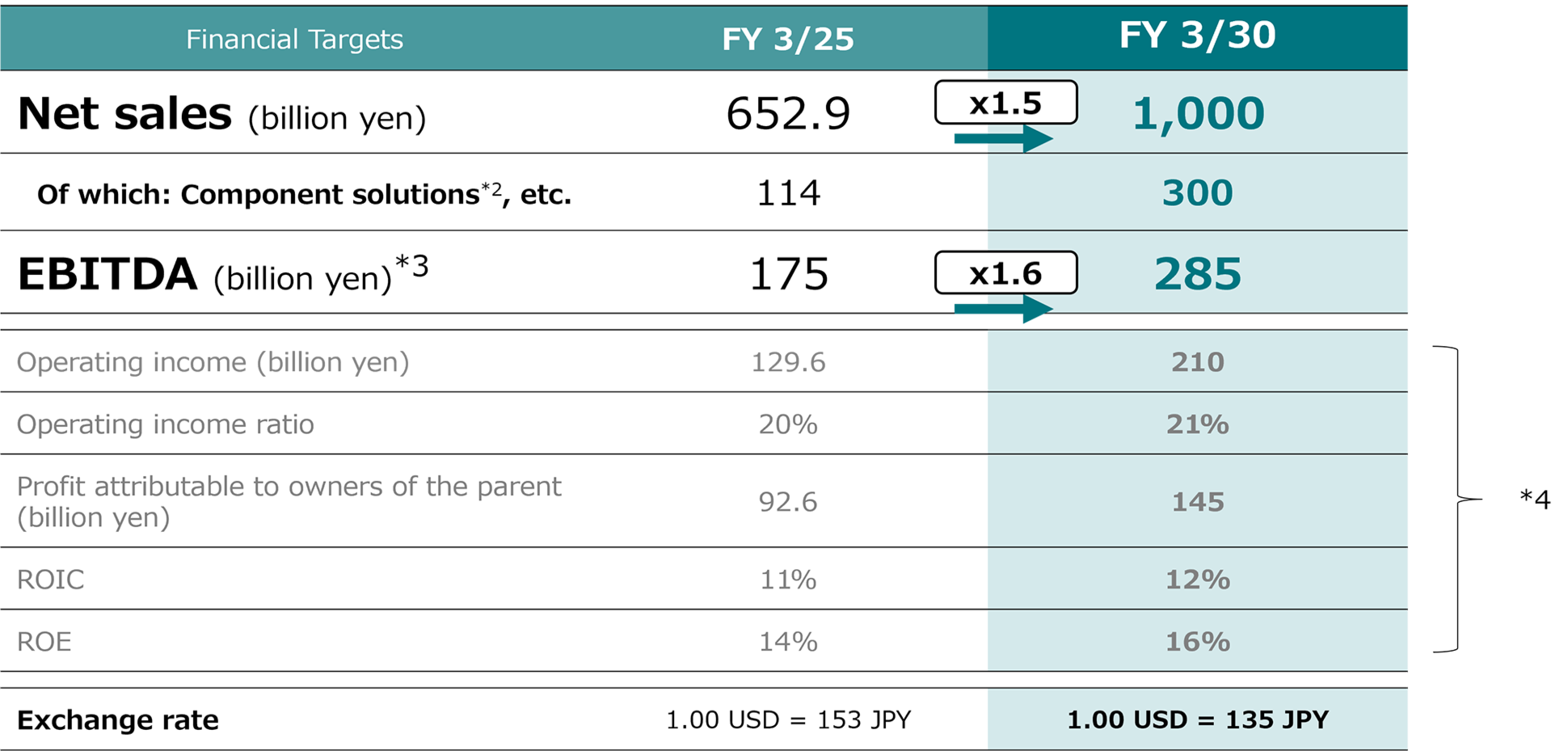
Performance targets. Revenue is projected to increase from 652.9 billion yen in FY25/3 to 1,000 billion yen in FY30/3 (1.5 times, including components, solutions, etc., from 114 billion yen to 300 billion yen). EBITDA is projected to increase from 175 billion yen to 285 billion yen (1.6 times). Operating profit is projected to increase from 129.6 billion yen to 210 billion yen, operating profit margin from 20% to 21%, net profit attributable to owners of the parent company from 92.6 billion yen to 145 billion yen, ROIC from 11% to 12%, and ROE from 14% to 16%. The exchange rate is projected to increase from 153 yen to 135 yen per dollar.
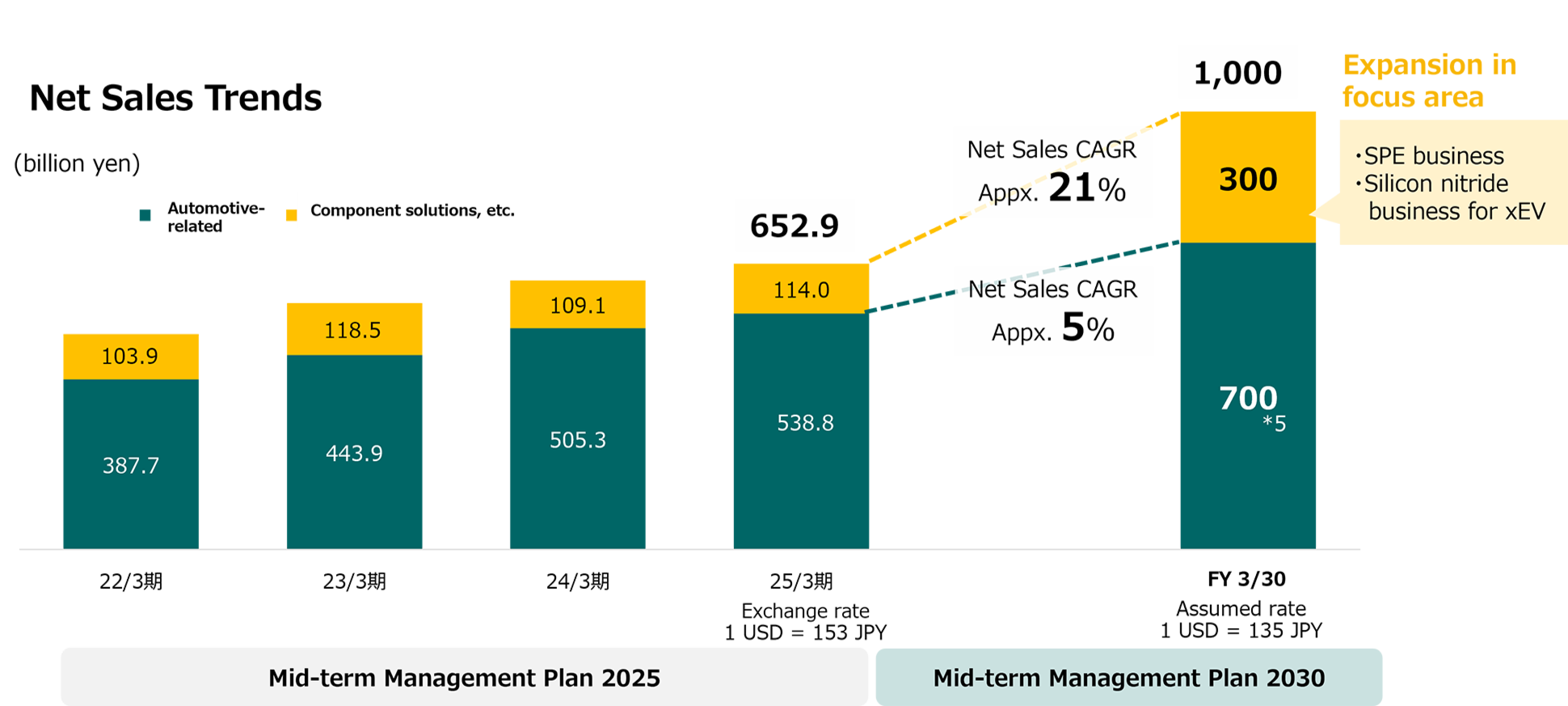
Trends in sales revenue (billion yen). FY22/3: 4,916, FY23/3: 5,624, FY24/3: 6,144, FY25/3: 6,529 (Automotive-related: 5,388 / Component Solutions and Others: 1,140), FY30/3: 10,000 (Automotive-related: 7,000 / Component Solutions and Others: 3,000). The CAGR for sales revenue of Component Solutions and Others is approximately 21%, and for Automotive-related businesses it is approximately 5%.

*1: "Internal Combustion Engine (ICE) business" in the long-term management plan

*2: "Non-ICE business" in the long-term management plan

*3: EBITDA: Operating income + Depreciation and amortization + Impairment loss

*4: Operating income and related items are figures calculated based on certain assumptions for purchase price allocation (PPA) of M&A projects and related amortization.

*5: Includes impact from the partial business acquisition from DENSO.

Cash allocation

Cash will be concentrated on our core domains (mobility, semiconductors, environment and energy) to support sustainable growth.

In addition to dividends, we will enhance shareholder returns by implementing additional payouts through share buybacks while maintaining financial stability.

As a result, we anticipate EBITDA to expand by 1.6 times by 2030.
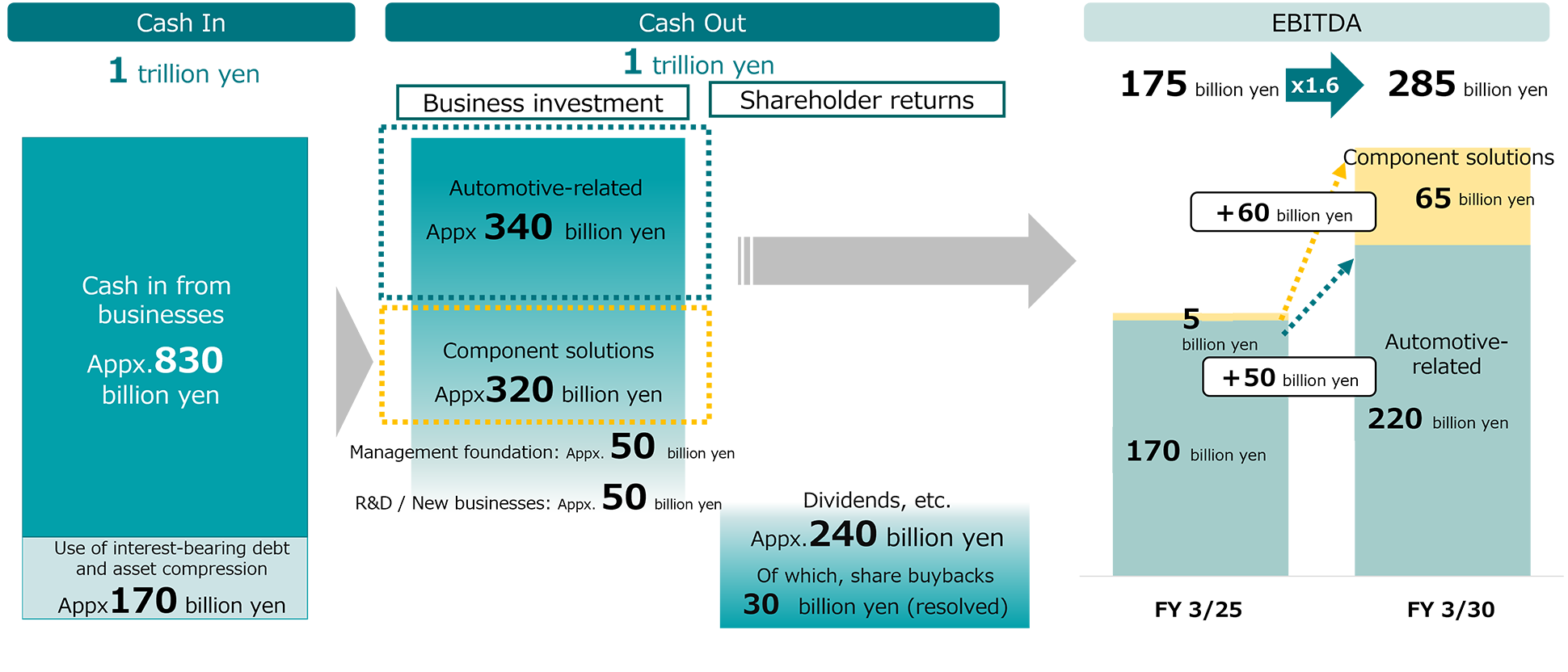
Cash allocation. Cash inflows amounted to 1 trillion yen (approximately 830 billion yen from business operations, and approximately 170 billion yen from the utilization of interest-bearing debt and asset reduction). Cash outflows also amounted to 1 trillion yen, consisting of business investments (approximately 340 billion yen in automotive-related businesses, approximately 320 billion yen in component solutions, approximately 50 billion yen in management infrastructure, and approximately 50 billion yen in research and development/new businesses) and shareholder returns (approximately 240 billion yen in dividends, of which 30 billion yen has been approved for share buybacks). EBITDA increased 1.6 times from 175 billion yen in FY25/3 to 285 billion yen in FY30/3.

Medium-Term Management Plan 2030(3.1MB)

Please refer to the following presentation materials for the Medium-term Management Plan for the fiscal years ending March 2026 to March 2030.

Long-Term Management Plan 2030(1.1MB)