



Management of Chemical Substances
Basic Philosophy
Chemical substances are used in various aspects of daily life as well as in industrial fields due to their many excellent functions. On the other hand, some are harmful to people and the environment, and regulations on hazardous chemical substances are becoming stricter worldwide year by year as public concern grows. As a manufacturing company that uses chemical substances as raw materials, our group considers the proper management of chemical substances to be one of our social responsibilities. Our group has set a vision of "continuing to implement appropriate chemical substance management and contributing to biodiversity conservation" as its target for 2040, and a goal of "implementing appropriate chemical substance management and reducing environmental impact" as its target for 2030. Furthermore, we will promote the proper management of chemical substances throughout our supply chain.
Chemical Substance Management System
Our group has established a management system for handling environmentally hazardous substances that consists of three stages: (1) responding to customer requests, (2) handling within our group, and (3) procurement from our business partners.
In addition to ensuring compliance with legal regulations and customer requests, we are committed to reducing the use and emission of environmentally harmful substances to minimize their impact on the environment and human health.
Responding to customer requests
In response to stricter regulations on chemical substances contained in products, we are receiving increasingly strong requests for compliance from our customers, including those in the automotive and electrical/electronic industries. We are committed to understanding the presence of chemical substances in our products that are subject to regulations such as Japan's Chemical Substances Control Law, Europe's REACH Regulation, the POPs Convention, and the US TSCA Regulation. When requested by our customers, we strive to respond appropriately by promptly submitting various data such as non-containment declarations, IMDS, and chemSHERPA, and by cooperating with investigations and audits regarding our management systems.
Handling within our group
To appropriately respond to increasingly stringent global chemical substance regulations, we implement measures to ensure that certain chemicals are not included in our products and that their use is controlled in our factories. For hazardous chemical substances, we have established hazard ranks according to the severity of the regulations and their harmfulness, and have defined handling standards for each rank. Moving forward, we will continue to strive to ensure compliance with legal regulations and customer requirements by substituting hazardous chemical substances and strengthening our management processes.
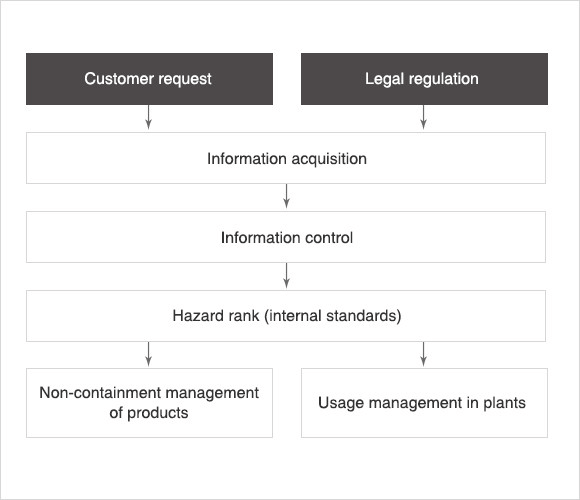
Hazard Rank
| Rank | Handling Standards | Target substance |
|---|---|---|
| Prohibited | Use is prohibited. | Substances whose use is prohibited or severely restricted by laws and regulations. |
| Limit | Develop an alternative plan and reduce usage. | Substances that are dangerous and hazardous, equivalent to prohibited substances, and whose properties make it impossible to immediately replace them. |
| Needs monitoring | To determine whether or not the purchased materials related to the product contain the substance. | Substances that are not prohibited or restricted, but whose presence in products must be monitored. |
Management of PRTR-listed substances
Each department ensures the identification and aggregation of PRTR-targeted substances, and strives for appropriate management by understanding the handling volume, discharge volume, and transfer volume.
Targets and initiatives for reducing VOC air emissions
We have set voluntary reduction targets for volatile organic compounds (VOCs), which are one of the causes of air pollution, and are promoting initiatives to address this issue.
We will systematically introduce and operate exhaust gas treatment equipment with a removal rate of 90% or more, prioritizing locations with particularly high emissions. Through this, we aim to reduce VOC atmospheric emissions by 50% by 2030 (compared to fiscal year 2021).
Procurement from our business partners
To properly manage the chemical substances contained in our products, the cooperation of our business partners is essential. Therefore, we ask our business partners to ensure that their products do not contain hazardous chemical substances prohibited by our company, as outlined in the "Green Procurement Handbook" and the "Niterra Group Prohibited Substances List," which are appendices to our group's sustainability procurement guidelines.