



Proper Procurement
Procurement Policy
We aim to realize globally optimal procurement based on our quality products principle. To this end, we focus on strengthening cooperation with suppliers and promoting our CSR and sustainability efforts throughout our supply chain system, while at the same time striving to carry out proper purchasing transactions when procuring materials and parts, based on the following guidelines:
Action Guidelines
- We conduct transactions at appropriate prices based on fair, transparent, open competition and rationality.
- We comply with procurement-related laws and regulations and foster responsible procurement. We select suppliers based on comprehensive assessment of product quality, technology, prices, deliveries, CSR and sustainability initiatives, and efforts to continuously make improvements.
- We aim to build a stable procurement system to prepare for changes in the external environment, such as geopolitical risks, natural disasters, and pandemics.
- To reduce the burden on the global environment, we strive to procure sustainable materials, including recycled materials.
- We enhance mutual trust with our suppliers, who are good partners for us, and strive to realize mutual development.
Basic Philosophy ~Promoting Responsible Procurement~
We take the current social and environmental challenges related to supply chains very seriously. We not only comply with various laws and regulations, including the Proper Transactions Act (formerly the Subcontracting Act), but we also promote responsible procurement activities that consider human rights and the environment. By meeting societal expectations throughout the entire supply chain, together with our diverse business partners, we will contribute to the realization of a sustainable society.
Promotion System
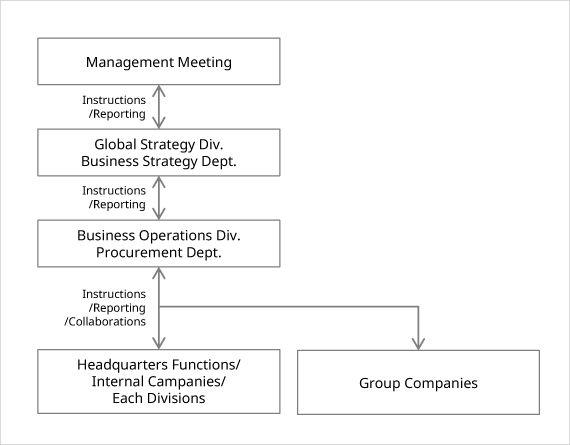
Our group, together with our business partners, is working to meet societal expectations throughout the entire supply chain and promote responsible procurement that takes into account human rights, the environment, and other factors. To this end, the Business Strategy Office of the Global Strategy Headquarters and the Procurement Department of the Business Operations Headquarters are at the forefront of controlling and optimizing procurement across the entire group.
Supervisory System
The progress and challenges related to procurement activities are reported to the management meeting, and important matters are reported to the board of directors.
Strategy and Control
The Business Strategy Department within the Global Strategy Division takes the lead in formulating procurement strategies and common rules for the entire group, and is responsible for establishing a control system for risk management and compliance within our group's supply chain.
Management of Procurement Risk and Compliance Systems
The Procurement Department of the Business Operations Division is responsible for optimizing procurement transactions and purchasing processes, including those of domestic and international group companies, implementing risk management activities throughout the supply chain, and managing the procurement compliance system. This includes disseminating information on procurement-related laws and guidelines for business partners, regularly reviewing the operational status of procurement transactions, correcting any deficiencies, and analyzing the causes of violations in procurement operations and verifying measures to prevent recurrence.
On-site Collaboration and Operation
At our head office, each company, each division, and each department of our domestic and international group companies, we ensure strict adherence to procurement rules and relevant laws and regulations, and we establish and operate appropriate business processes to prevent negligence and fraudulent activities.
Supply Chain Management
Our Supply Chain
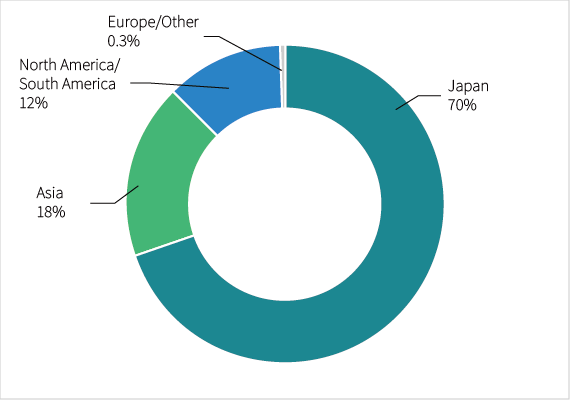
Our company conducts procurement activities globally, utilizing the advantages of both centralized and decentralized purchasing, and also employing local procurement at our overseas manufacturing plants for the purpose of optimizing procurement.
Customer management at our company
At our company, the procurement department is primarily responsible for managing our suppliers, and in addition to checking and investigating aspects such as quality, price, delivery time, and sustainability, we also consider their commitment to improvement as conditions for doing business with them.
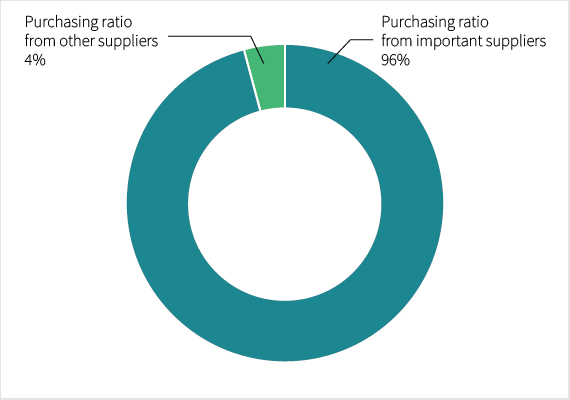
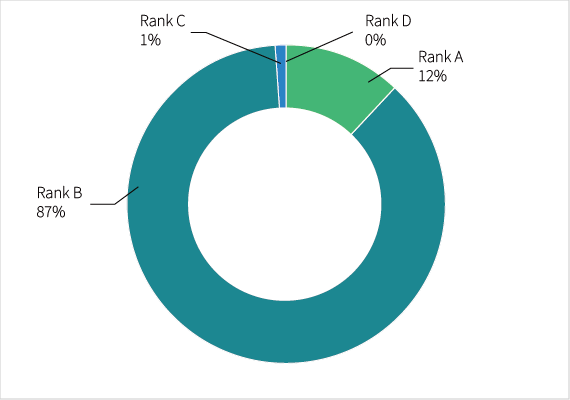
In particular, we consider our suppliers who provide us with components, processing equipment, and other materials related to the manufacturing of our products to be important suppliers. We conduct annual evaluations of these suppliers based on the above-mentioned criteria for supplier management, ranking them from A to D, and using this feedback to encourage continuous improvement.
In fiscal year 2025, we reached out to 87.8% of our business partners who received a B to D rank to encourage improvement. We will continue to provide guidance and support in the future.
| Rank | Response policy |
|---|---|
| A | Prioritize obtaining quotes. Become a potential technology partner for joint development, etc. |
| B | We point out weaknesses and provide guidance to encourage improvement. |
| C | We will request improvements based on the improvement request form. We will also instruct them to aim for a B rank or higher. |
| D | We will confirm whether they have the intention to improve, and continue the business relationship while conducting regular follow-up/checks for improvements. |
Procurement Guidelines Regarding Fair Transaction Prices
Our group has established procurement guidelines for fair transaction prices in accordance with the "Guidelines on Price Negotiations for Appropriate Pass-Through of Labor Costs" issued by the Japan Fair Trade Commission, and we are ensuring that these guidelines are thoroughly communicated to all our employees. By making this a shared understanding throughout the company, we will continue to maintain fair trade practices.
Promoting Sustainability Procurement
To promote sustainability initiatives throughout our entire supply chain, we have issued and are distributing our "Sustainability Procurement Guidelines" to our business partners.
Furthermore, when we revised these guidelines in fiscal year 2025, we held an explanatory meeting to help our business partners better understand the revisions, and many of them participated.
Sustainability Procurement Guidelines
The "Sustainability Procurement Guidelines" outline the requirements that our business partners must adhere to regarding the environment, human rights and labor, business continuity planning (BCP), business ethics, information security, occupational health and safety, and quality and safety. We require all our business partners to implement and comply with these guidelines as a prerequisite for our business relationships. We include clauses regarding compliance with these guidelines in our basic business agreements and ask that our business partners work together with the Group to implement them. We also request that our business partners share these guidelines with their suppliers.
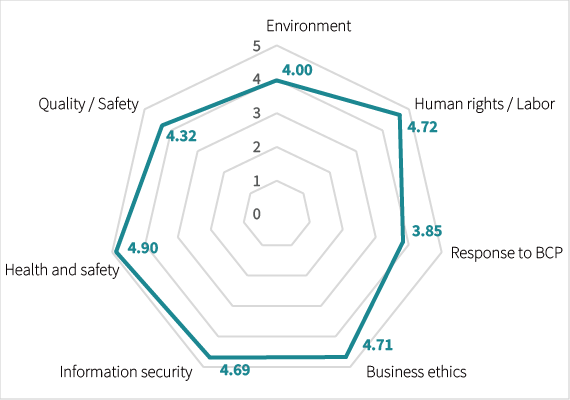
We survey our business partners' efforts every two years using a checklist. This checklist includes a section for confirming agreement to comply with these guidelines, and we reconfirm this agreement at the time of the survey. In the survey conducted in fiscal year 2025, we targeted approximately 920 companies with whom we have regular business transactions, and received responses from 71% of our business partners (based on the number of companies; equivalent to 86% based on total purchase amount), and 67% of our business partners (based on the number of companies; equivalent to 74% based on total purchase amount) agreed to comply with these guidelines. We scored the results, and for business partners with high risk concerns, we conducted follow-up interviews with management and requested improvements to address the issues. For business partners who have not agreed to the guidelines, we will continue dialogue to ensure their understanding.
Furthermore, as an appendix to these guidelines, we have also established a "Green Procurement Manual" aimed at reducing environmental impact throughout the supply chain, and we ask our business partners for their cooperation in our group's green procurement efforts.
- Sustainability Procurement Guidelines (Japanese version)
- Attachment: Green Procurement Guidance (Japanese version)
- Niterra Group Prohibited/Restricted Substance List (Japanese version)
- Sustainability Procurement Guidelines
- Attachment: Green Procurement Guidance
- Niterra Group Prohibited/Restricted Substance List
FY2025 Survey Results by Check List
Internal education on sustainability procurement
Sustainability training for our procurement department
To improve our knowledge of sustainability, we conduct sustainability training for our procurement staff.
In fiscal year 2025, more than 100 procurement department personnel participated in the training.
"Niterra Group Procurement Compliance Training" for Group Employees
To ensure thorough adherence to procurement compliance, Niterra Group conducts annual procurement compliance training and comprehension tests for all group employees.
Human Rights Initiatives
In order to respect the human rights of our business partners and all those involved with their suppliers, we have established prohibitions and other matters related to human rights in our "Sustainability Procurement Guidelines."
In addition, we conduct surveys on human rights initiatives, regularly check the status of our business partners' efforts, and use feedback from our company to encourage improvements in areas where their efforts are lacking.
Furthermore, regarding the issue of conflict minerals, there are concerns that some of the mineral resources extracted in the Democratic Republic of Congo and surrounding countries may be funding armed groups and contributing to human rights abuses and conflicts. Our group also recognizes this as one of the important social issues in resource and raw material procurement.
Therefore, in February 2025, we established the "Guidelines for Responsible Mineral Sourcing," which outlines our approach to responsible mineral sourcing.
Procurement Policy <Appendix>
Niterra Group Responsible Mineral Procurement Guidelines
Basic Philosophy
The Niterra Group promotes responsible minerals sourcing that considers human rights, environmental impacts, and other relevant factors as part of its CSR and sustainability procurement efforts.
To avoid involvement in Annex II risks*1 in the Democratic Republic of Congo (DRC) and its neighboring countries*2 and other conflict-affected and high-risk areas (CAHRAs)*3, we do not use conflict minerals in our products. If the use of conflict minerals is identified, we will take steps to eliminate their use. However, minerals that are legally sourced and traded from the DRC and its neighboring countries or CAHRAs may be used.
Major Initiatives
- We will establish a management system in accordance with the OECD Due Diligence Guidance for Responsible Supply Chains of Minerals from Conflict-Affected and High-Risk Areas.
- We will conduct upstream supply chain investigations on the use of conflict minerals using internationally recognized tools such as the Conflict Minerals Reporting Template (CMRT) and the Expanded Minerals Reporting Template (EMRT). In addition, we will require our suppliers to procure from smelters/refineries that are compliant with the Responsible Minerals Assurance Process (RMAP).
*1 "Annex II Risks" refer to the risks, etc., listed in Annex II of the OECD Due Diligence Guidance for Responsible Supply Chains of Minerals from Conflict-Affected and High-Risk Areas, which may be associated with conflict or human rights abuses.
*2 "The Democratic Republic of the Congo (DRC) and its neighboring countries" refers to the region covered by the U.S. Dodd-Frank Act, which includes the Democratic Republic of the Congo, South Sudan, Uganda, Rwanda, Burundi, Tanzania, Zambia, Angola, Republic of the Congo, and Central African Republic.
*3 "Conflict-Affected and High-Risk Areas (CAHRAs)" refer to the countries and regions that are listed by the EU pursuant to the EU Conflict Minerals Regulation.
Efforts to address climate change
In order to work towards carbon neutrality throughout the entire supply chain, including our business partners, we are requesting your cooperation in setting CO2 reduction targets and conducting CO2 emission surveys related to products supplied to our company.
Setting CO2 reduction targets
Our "Sustainability Procurement Guidelines," which we provide to our business partners, stipulate that they must set CO2 reduction targets and promote reduction efforts.
Approximately 60% of our business partners have already set CO2 reduction targets, and we will continue to encourage those who have not yet set targets to do so. (As of the 2025 survey)
Survey of CO2 emissions related to products for our company
In order to understand the CO2 emissions related to our company from our business partners, we have been conducting surveys on CO2 emissions related to products supplied to us since fiscal year 2022, and we will continue to conduct these surveys in the future.
Support for reducing CO2 emissions across the entire supply chain
We provide support to all our business partners through seminars and materials on reducing CO2 emissions, as well as support tailored to their level of commitment and on-site support upon their request. Furthermore, to address challenges such as a lack of know-how and personnel among our small and medium-sized business partners, we are participating as a lead company in the "Supply Chain Team-Up Project" publicly solicited by the Ministry of Economy, Trade and Industry. In this project, we are sharing case studies and conducting calculation exercises through "Carbon Neutrality Awareness Building Meetings" for our business partners, and providing support for developing individual roadmaps using a decarbonization plan formulation system.
Our group will strengthen our engagement with our business partners and suppliers and promote initiatives as a partner throughout the entire supply chain.
- Initiatives to Promote CN in the Supply Chain: Proactive Support for Small and Medium-Sized Suppliers as Part of Efforts to Reduce Scope 3 Emissions
- Selected as a lead company for the Ministry of Economy, Trade and Industry's decarbonization project, "Supply Chain Team-Up Project."
Appreciation for our business partners' proactive efforts
Our group recognizes and honors business partners who promote carbon neutrality initiatives, including CO2 reduction, by presenting them with the "Carbon Neutral Award."
Audit and support activities for our business partners
Through initiatives such as "support activities for underlying strength," audits of specific items including quality, and follow-up activities for regular evaluations of our business partners, we work together with our business partners to improve our relationships, deepen trust, and promote sustainability, risk management, and enhance manufacturing capabilities throughout the entire supply chain.
Implementation of support activities to help people develop their skills (seminars and on-site practical support)
Every year, we hold seminars for our business partners that focus on manufacturing, such as training on how to read blueprints and root cause analysis. On the other hand, our on-site practical support involves going into our business partners' manufacturing sites and working on improvements. Based on 5S activities aimed at improving safety and efficiency in our business partners' manufacturing sites, we provide guidance on the placement and labeling of items, the clear designation of safety zones, etc., and confirm areas for improvement. In addition, we award certificates of completion after a follow-up six months later, and conduct follow-up checks again in the following period to ensure that the improvements are retained.
In fiscal year 2025, we provided support to nine of our clients through seminars and on-site practical training.
Audit and implementation support for quality management systems (ISO/IATF)
Our quality control department takes the lead in conducting quality audits of our business partners. If the audit reveals that the management system is insufficient, we provide support for improvement. In fiscal year 2025, we conducted audits of 36 business partners and provided support to 69 of them.
Follow-up activities for regular evaluations of our business partners
We conduct regular evaluations of our business partners once a year and communicate the results to them. For business partners who require particular follow-up, we conduct improvement activities such as visiting them to discuss their problems, inspecting their operations, and working together to consider what improvements can be made to overcome their weaknesses. We also recognize outstanding business partners with awards.
In fiscal year 2025, we recognized 11 of our business partners.
Declaration of Partnership Building
Our company endorses the "Partnership Building Declaration" established by the "Council for Promoting the Building of Partnerships to Open Up the Future" *, and has published our own declaration. We are committed to mutual prosperity throughout the entire supply chain, new collaborations that transcend size and affiliation, and adherence to the "Promotion Standards," while also practicing appropriate purchasing transactions based on our procurement policy.
* Members include the Chairman of the Japan Business Federation, the President of the Japan Chamber of Commerce and Industry, the President of the Japanese Trade Union Confederation, and relevant ministers (Cabinet Office, Ministry of Economy, Trade and Industry, Ministry of Health, Labour and Welfare, Ministry of Agriculture, Forestry and Fisheries, Ministry of Land, Infrastructure, Transport and Tourism).
Helpline for our business partners
We have established a "Helpline" to receive reports from our business partners regarding violations by our group's officers and employees.
For more details, please refer to the brochure distributed to our business partners.