



Response to Climate Change
Basic Philosophy
Reducing greenhouse gas emissions to mitigate climate change is an urgent and critical global challenge, and a priority for our group. In particular, as a manufacturing company, we believe that reducing CO2 emissions is a responsibility that our group must fulfill.
In our "Eco Vision 2030," our group has declared a CO2 emission reduction target of "46% reduction by FY2030 compared to FY2018" (Scope 1 & 2). We are also promoting CO2 emission reductions in our supply chain and product lifecycle, aiming for "30% reduction by FY2030 compared to FY2018" (Scope 3). Furthermore, we have set a target of "71.4% reduction by FY2035 compared to FY2018" (Scope 1 & 2) by the end of FY2024.
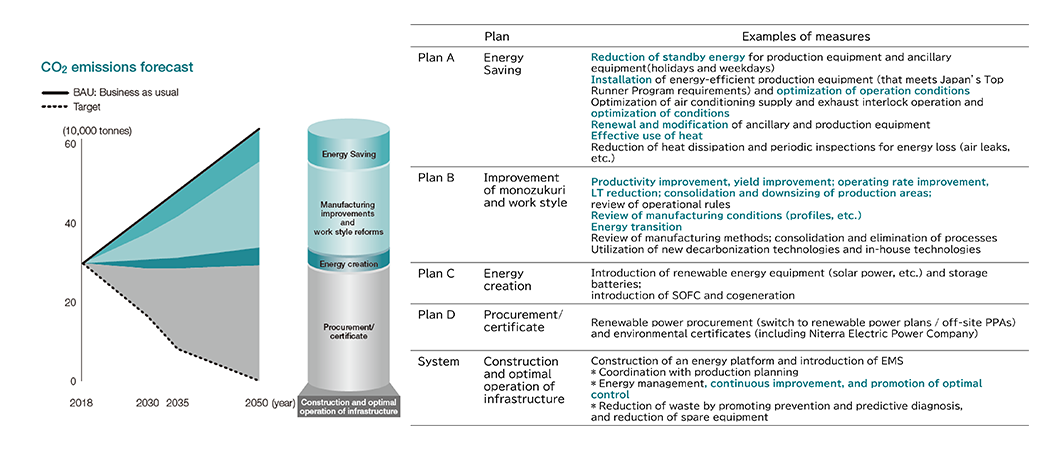
Our efforts will primarily involve implementing various measures based on four plans: "Plan A: Energy Conservation," "Plan B: Manufacturing and Work Style Improvement," "Plan C: Energy Creation," and "Plan D: Procurement and Certificates," in order to achieve both planned CO2 emission reduction and economic growth.
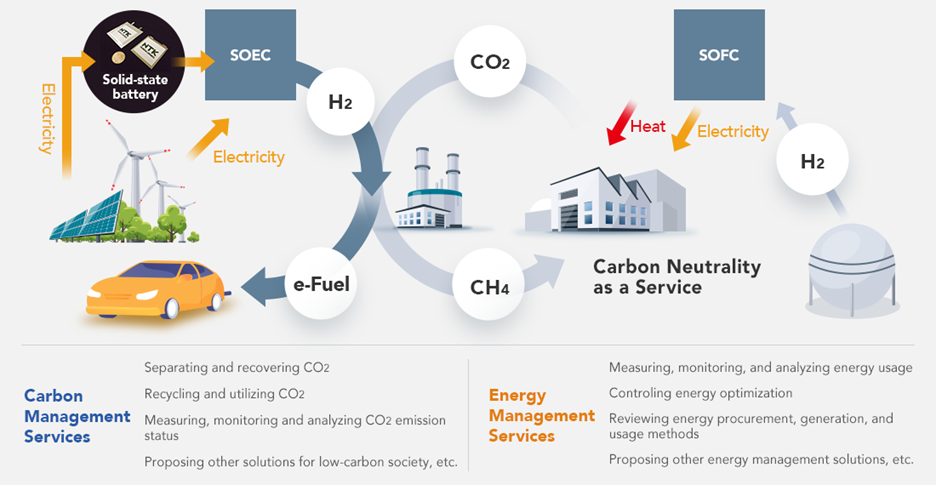
We are also working on building a carbon-recycling system and utilizing hydrogen.
Our Group's efforts to reduce CO₂ emissions (Scope 1 & 2)
Scope 1 and 2 target values
| Item | Target |
|---|---|
| Scope 1 & 2 |
|
*2 We have already obtained SBT WB2℃ certification under the previous target (30% reduction by FY2030), and we plan to apply for renewal to SBTi next year for the new target.
* Scope 1 and Scope 2 emission figures for each fiscal year since the base year (FY2018) have been calculated and verified by an independent third-party organization (third-party verification report available here).
CO2 emission reduction measures by 2050
Our group is promoting a medium- to long-term plan to reduce greenhouse gas emissions (Scope 1 and 2) associated with our business activities. We are currently updating our plan to determine the optimal contribution ratio for each reduction measure, and we will announce the new breakdown of measures as soon as it is finalized. During this transition period, we will continue to implement energy-saving measures and production process reviews at each of our sites (Plans A to C), while simultaneously introducing renewable energy and utilizing environmental certificates (Plan D). We will work to gradually reduce emissions from both operational improvements at our own sites and energy procurement.
"Plan A: Energy Saving" initiative
Initiatives at the production site
When introducing new production equipment, we use a checklist to ensure energy-saving design. For existing production equipment and ancillary facilities, we are working on equipment improvements to reduce standby energy consumption during holidays and nights.
Furthermore, to prevent energy losses such as air leaks due to equipment deterioration over time, we systematically conduct periodic inspections and maintenance.
Office initiatives
In addition to switching to LED lighting and turning off lights and PCs during breaks, we are also promoting Cool Biz in the summer and Warm Biz in the winter, and saving energy by properly managing temperature, humidity, and ventilation.
"Plan B: Manufacturing and Work Style Improvement" Initiative
Initiatives at the production site
We regularly review our manufacturing conditions (profiles) to avoid excessive energy consumption during production. Furthermore, CO2 emissions for each company are visualized on our internal dashboard, and each site is working on daily improvement activities to achieve the most energy-efficient production possible. These improvement examples are then implemented at each site, and the entire group works together to promote energy conservation.
"Plan C: Energy Creation" initiative
Renewable energy
We are promoting the use of renewable energy sources such as solar, hydroelectric, and geothermal energy.
The main locations where we currently have renewable energy facilities installed are listed below. We will continue to install facilities systematically in the future.
| Renewable energy | Country | Company/Plant Name | Nominal power generation capacity (kW) | |
|---|---|---|---|---|
| Solar power | Japan | Niterra Co., Ltd. | Komaki Plant | 882 |
| Ise Plant | 2640 | |||
| SparkTec WKS CO., LTD. | Nino Plant | 193 | ||
| Satsuma Plant | 1092 | |||
| CERAMIC SENSOR CO., LTD. | Nakatsugawa Plant | 1216 | ||
| NTK CERATEC CO., LTD. | Head Office Plant | 422 | ||
| China | Niterra (Shanghai) Co., Ltd. | 400 | ||
| Niterra (Changshu) Co., Ltd. | 978 | |||
| Thailand | Siam Niterra Co., Ltd. | 389 | ||
| Niterra (Thailand) Co., Ltd. | 1679 | |||
| Niterra ASIA Co., Ltd. | 3637 | |||
| India | Niterra India Private Limited | 574 | ||
| Indonesia | PT Niterra Mobility Indonesia | 220 | ||
| Australia | Niterra Australia Pty. Ltd. | 175 | ||
| Brazil | Niterra do Brasil Ltda. | 3413 | ||
| Geothermal heat pump | Japan | SparkTec WKS CO., LTD. | Okusa Plant | ー |
| Small-scale hydroelectric power | Niterra Co., Ltd. | Komaki Plant | ー | |
For actual power generation figures, please refer to our sustainability data.
Fuel cells
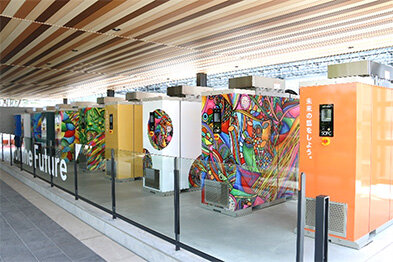
We have introduced SOFCs (Solid Oxide Fuel Cells) to the "N-Terrace" demonstration facility, newly established in July 2026 at the Nino Plant of our group company, SparkTec WKS. This SOFC incorporates a cell stack manufactured by our group company, MORIMURA SOFC TECHNOLOGY, and boasts a high power generation efficiency of approximately 63%, while supplying electricity that does not emit CO₂ during the power generation process (excluding emissions associated with the hydrogen production process). Currently, we are conducting demonstrations of optimal control technology by linking it with a solar power generation system, storage batteries, and an AI-powered energy management system (EMS).
"Plan D Procurement and Certificates" initiative
Efforts to introduce CO2-free electricity
Our head office, SparkTec WKS Satsuma Plant and Satsuma Electrode Plant, and Niterra Materials Oita Plant all utilize 100% CO2-free electricity. Other domestic locations also partially utilize CO2-free electricity.
Going forward, we will continue to reduce electricity consumption, primarily through energy conservation activities, while systematically introducing CO2-free electricity.
Initiatives toward realizing a carbon-neutral society (carbon neutral as a service)
To contribute to the realization of a carbon-neutral society, we are developing methanation-related technologies (hydrogen production technology using ceramic solid electrolytes and CO2 capture technology using oxygen concentrator technology).
The connection between non-financial indicators (employee engagement) and climate change response in performance-linked stock compensation plans.
Our company has introduced a performance-linked stock compensation plan for directors (excluding directors who are audit and supervisory committee members and outside directors) and executive officers (excluding employed executive officers) with the aim of enhancing awareness of contributing to improved medium- to long-term performance and increased corporate value, and to share interests with our shareholders.
This system includes "employee engagement" as a non-financial indicator, in addition to medium-term performance indicators and shareholder value indicators. Employee engagement is an important indicator that shows the vitality and willingness to contribute of employees, which are the source of our group's sustainable growth, and our group places particular emphasis on the "sense of fulfillment" of each and every employee.
This sense of fulfillment is greatly fostered by the feeling that one is solving social issues through their business. For example, addressing climate change, such as reducing CO2 emissions, is a major factor in employees taking pride in their company's activities and feeling a sense of fulfillment. Furthermore, this sense of fulfillment is also enhanced by talent development and creating a comfortable working environment. Therefore, actively promoting these initiatives becomes an important evaluation criterion for management.
In this way, various non-financial initiatives, including climate change response, lead to improved employee engagement, which is ultimately reflected in performance-linked stock compensation.
Internal awareness-raising initiatives (internal carbon pricing, internal carbon tax, internal environmental fund)
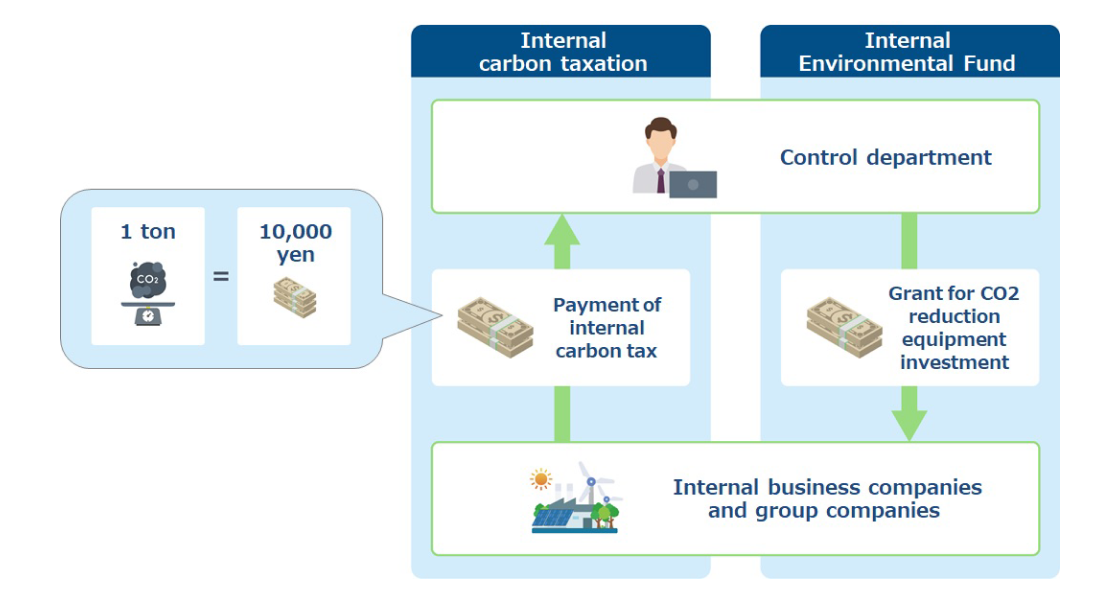
As awareness-raising measures to reduce Scope 1 and 2 emissions, we have introduced "internal carbon pricing," "internal carbon tax," and "internal environmental fund."
Regarding "internal carbon pricing," our group has set it at 10,000 yen per ton of CO2 emissions. The "internal carbon tax" is a system that collects that amount according to the CO2 emissions of each department, including internal companies and group companies. We expect this to have the effect of raising awareness and accelerating efforts to reduce CO2 emissions.
Furthermore, the "Internal Environmental Fund" is a mechanism that uses funds collected through the "Internal Carbon Tax" to provide subsidies for capital investments aimed at reducing CO2 emissions. As an example from fiscal year 2023, subsidies were provided for solar power generation equipment at the Ise Plant and the CERAMIC SENSOR Nakatsugawa Plant. When introducing equipment, a comprehensive environmental assessment is conducted, including not only CO2 emissions but also water and energy, and a decision is made by the management committee.
Reducing the overall environmental impact of the factory
SUISO no MORI hub
The "SUISO no MORI hub" located at the Komaki Plant is a base aiming for the early arrival of a hydrogen-based and carbon-recycling society, and is registered as a ZEB (Net Zero Energy Building). By employing high insulation performance, sun-blocking eaves, solar power generation panels, and desiccant air conditioning, the building is designed to achieve a 146% reduction in primary energy consumption (including energy creation) compared to a building with standard equipment.
N-FOREST
The "N-FOREST" office building at the Komaki Plant has achieved the highest rank, "S rank," in CASBEE (Comprehensive Assessment System for Built Environment Efficiency) due to its use of environmentally friendly materials and equipment, as well as its design that takes the landscape into consideration. Furthermore, in order to contribute to a decarbonized society, it utilizes a power generation system using solar power and SOFC (Solid Oxide Fuel Cell).
Satsuma Plant Employee Dormitory
The employee dormitory at SparkTec WKS Satsuma Plant has adopted ZEH (Net Zero Energy House) specifications. By combining "energy saving" through high insulation and high-efficiency equipment with "energy creation" through solar power generation, the aim is to achieve virtually zero energy consumption. Decarbonization is being actively promoted not only in production facilities but also in employee welfare facilities.
Rooftop greening
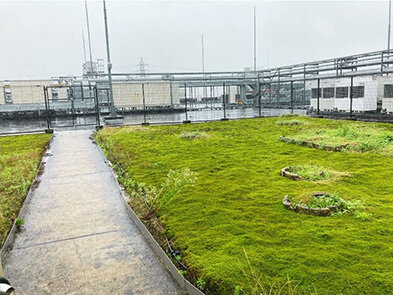
To expand green spaces and improve energy efficiency, we have installed green areas on the rooftops of a portion of our Komaki Plant.
Employee participation initiatives
This initiative involves our company receiving electricity with added environmental value, derived from surplus solar power generated at employees' homes *, from Chubu Electric Power Miraiz Co., Inc., and using it at our Komaki Plant. In addition, employees who provide the surplus electricity with environmental value will receive an incentive through Chubu Electric Power Miraiz Co., Inc..
Through this initiative, our company will work together with our employees to promote efforts to reduce CO2 emissions.
*This refers to renewable energy whose purchase period under the feed-in tariff system has expired.
Solar power generation system PPA service
As part of our group's energy creation activities, and with the aim of reducing CO₂ emissions not only within our group but also in the region, we are promoting a PPA (Power Purchase Agreement) service for businesses, in addition to our previous efforts, which can be taken part in by our business partners and the factories and stores that use our products. Our group company, Niterra Electric, will be the service provider, installing solar power generation systems at local factories and stores and supplying the generated electricity to the electricity users of those factories and stores. Any surplus electricity generated by the solar power will be utilized by our company, and in the future, we will use the generated electricity to produce and utilize hydrogen, thereby effectively contributing to a carbon-recycling society.
Efforts to reduce CO₂ emissions in the supply chain
Setting target values for Scope 3
| Item | Target |
|---|---|
|
Scope 3: Category 1: "Purchased Products and Services" |
30% reduction in FY2030 (compared to FY2018) |
Scope 3 refers to indirect greenhouse gas emissions other than Scope 1 and Scope 2 (emissions by other companies related to our business activities), and is classified into 15 categories.
At our company, Category 1 "Purchased Products and Services," Category 4 "Transportation and Delivery (Upstream)," and Category 11 "Use of Products Sold" account for 97.6% of our total Scope 3 emissions. Therefore, we have set targets for these three categories and are working to reduce CO2 emissions.
For Category 1, we require our business partners to set CO2 reduction targets and implement measures through our "Sustainability Procurement Guidelines," and we will provide necessary support according to the circumstances of each business partner.
For Category 4, as a designated shipper under the Energy Conservation Act, we are working to reduce CO2 emissions associated with transportation by shortening transportation distances through measures such as factory restructuring and consolidation, and reviewing waste disposal companies.
For Category 11, which accounts for the largest proportion of the total, we will proceed with initiatives such as designing products to improve energy efficiency during use.
Category 1: Initiatives related to "Purchased Products and Services"
Sustainability Procurement Guidelines
To promote sustainability initiatives throughout our entire supply chain, we have issued and are distributing our "Sustainability Procurement Guidelines" to our business partners.
This guideline outlines the requirements that our business partners must adhere to, including measures to address climate change, such as setting CO2 reduction targets and implementing related initiatives. We also request that our business partners share this guideline with their suppliers.
Category 4: Initiatives in "Transportation and Delivery (Upstream)"
Review of logistics routes
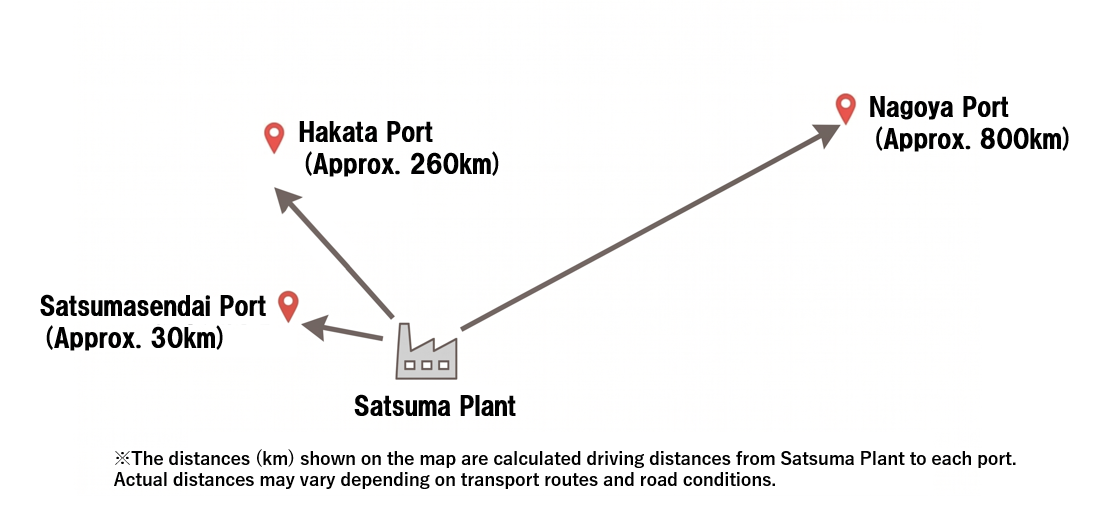
At SparkTec WKS Satsuma Plant, we are optimizing our logistics routes to shorten the land transport distance for product shipments. Previously, some logistics routes involved transporting products by land to Nagoya Port (approximately 800 km) or Hakata Port (approximately 260 km). Now, we have begun utilizing Satsumasendai Port (approximately 30 km), which is closer to the plant. By bringing transportation hubs closer together, we are striving to improve energy efficiency in land transport and reduce exhaust emissions.
Category 11: Initiatives related to "Use of products sold"
Improved fuel efficiency through high-performance plugs
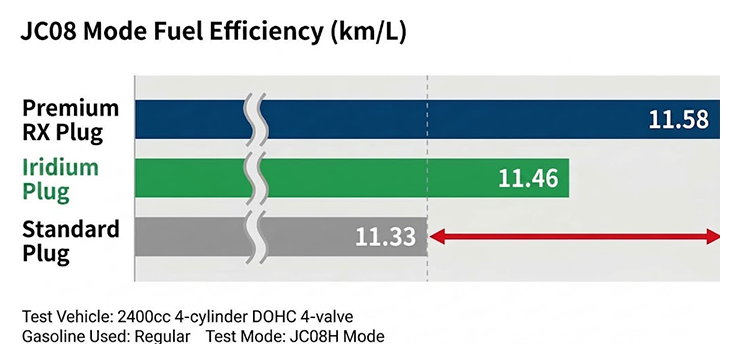
Our group is promoting the development and widespread adoption of fuel-efficient spark plugs to reduce the environmental impact during product use.
In our designated in-house evaluation tests *1, we confirmed that the Premium RX plug improves fuel efficiency in JC08H mode driving by approximately 2.2%, from 11.33 km/L to 11.58 km/L compared to the standard plug (our general product).
*1 Test conditions: 2400cc 4-cylinder DOHC 4-valve vehicle, using regular gasoline, measured in JC08H mode. Actual fuel efficiency may vary depending on the vehicle model, driving conditions, and other driving environment factors.
Calculation of product carbon footprint (CFP)
Carbon footprint (CFP) is a system that visualizes the total amount of greenhouse gases emitted throughout the entire lifecycle of a product or service, from raw material procurement to manufacturing, distribution, use, disposal, and recycling, by converting it into CO2 emissions. Our group considers CO2 reduction across the entire value chain to be a critical issue and is working to reduce the environmental impact throughout the product lifecycle.
Our group is calculating CFP (Chemical Flux Factor) primarily in the upstream of the value chain and our own production processes within the product lifecycle, in order to understand the current emission structure and assist in reduction efforts. These CFP calculations refer to ISO 14040, ISO 14044, and ISO 14067. Furthermore, to promote CO2 reduction throughout the entire value chain, we respond to customer requests for CFP-related data.
Furthermore, we will work to systematize a company-wide management system to ensure that CFP is taken into consideration during the development of new products.
Expanding disclosure of information on climate change-related risks and opportunities
In July 2020, our group expressed its support for the recommendations of the TCFD (Task Force on Climate-related Financial Disclosures).
Based on the recommendations of the TCFD, we will examine the impact of climate change on our group's business, strategy, and finances within the framework of our company-wide risk management, and discuss these issues in the Risk Management Committee and the Sustainability Committee. We will also promote voluntary and proactive information disclosure.
Collaboration with the local community
Our group is actively working to reduce CO₂ emissions and introduce renewable energy at each of our business locations.
In February 2025, NTK CERAMIC CO., LTD. signed a cooperation agreement with Iijima Town, Kamiina District, Nagano Prefecture, where its production base is located, to work towards carbon neutrality. Iijima Town declared its commitment to carbon neutrality in October 2022, aiming to achieve net-zero carbon dioxide (CO₂) emissions by 2050.
Participation in industry associations and initiatives
As our group promotes initiatives to address climate change, we support public policies and regulations related to climate change and participate in the following:
- TCFD (Task Force on Climate-related Financial Disclosures)
- SBTi (Science Based Targets Initiative)
- GX Future Consortium
- Japan Auto Parts Industries Association, CN/Energy Conservation Committee