
Respect for Human Rights
Human Rights Policy
We are working to resolve various social issues to realize sustainable societies. We recognize that as a prerequisite for this, it is important to respect human rights of people who are affected by our business activities, and that it is essential to continuously fulfill such responsibilities in truly contributing to the realization of sustainable societies. To this end, we respect human rights set out in the Universal Declaration of Human Rights and the ILO Declaration on Fundamental Principles and Rights at Work, and make our best efforts to protect the dignity of these people based on the UN Global Compact, the UN Guiding Principles on Business and Human Rights, and the OECD Guidelines for Multinational Enterprises.
Action Guidelines
- We comply with the laws and regulations of all countries and regions in which we conduct our business activities. If where national laws and international human rights differ, we seek ways to respect internationally recognized human rights wherever possible.
- We identify negative impacts that we could have on human rights through our business activities, and strive to prevent, mitigate, or eliminate the causes of such impacts.
- We establish a scheme for our employees and suppliers to access or report, and accept consultations and notifications concerning human rights. Upon receiving consultations or notifications, we investigate the facts, and if any problem is identified, we remedy it through appropriate response.
- We disclose efforts and progress promptly on human rights actions and keep updating ones through discussions and dialogues with various internal and external stakeholders.
- This policy applies to all Corporate Officers and employees of the Group. We provide appropriate education and trainings to ensure that all Corporate Officers and employees understand and act with this policy.
- We consistently require all of our business partners, including suppliers, to understand the Policy and join our efforts to respect human rights.
<Appendix>
The Policy is top-ranked guideline on human rights actions and had been confirmed by our CSR and Sustainability Committee and approved by Board of Directors’ meeting. The Policy shows the Group’s approach on human rights and complements our Corporate Philosophy, CSR and Sustainability Charter, and Corporate Code of Conduct.
The Policy will be periodically updated in response to changing social and business environment and human right issues, through discussions and dialogues with stakeholders. We keep adequate management system and reflect updates on relevant business policies and procedures to integrate in entire business activities.
The human rights that the Group respects in its corporate activities include the following:
[Prohibition of forced labor]
We do not tolerate forced labor and human trafficking, and we employ employees on their own volition.
[Prohibition of inhumane treatment]
We do not engage in inhumane treatment such as abuse, corporal punishment, sexual harassment, or power abuse, and we respect the human rights of our employees.
[Prohibition of child labor]
We respect rights of children and do not employ them under the minimum age for employment in the country or region. Workers under the age of 18 shall not perform work that is likely jeopardize the healthy development.
[Prohibition of discrimination]
We prohibit discrimination of any kind, irrespective of race, color, age, gender, sexual orientation, gender identity, ethnicity, nationality, disability, pregnancy, religion, union membership, protected genetic information, or marital status.
[Working conditions and equal opportunity]
We comply with the laws and regulations of each country and region, such as minimum wages, overtime wages, equal pay for equal work, working hours, etc., offer working conditions for a better life for our employees, and do not unreasonably reduce wages. We also ensure equal opportunities and equity in hiring, promotion, and compensation.
[Freedom of association and collective bargaining]
We respect freedom of association and the right to collective bargaining in accordance with the laws and regulations of each country and region.
[Responsible procurement of resources and materials]
We promote responsible procurement of resources and materials, taking into consideration human rights issues, including those relating to conflict minerals. If any use of such minerals is found, we will take appropriate measures.
[Respect for privacy]
We respect and do not infringe on the privacy of individuals.
[Comfortable workplace environment]
We comply with the laws and regulations concerning safety, hygiene and health in each country and region, strive to reduce long working hours and create a safe, healthy and comfortable workplace environment.
[Respect for the rights of Indigenous Peoples and local communities]
In business activities in areas where indigenous peoples reside, we recognize that indigenous peoples have their own unique cultures and histories, and we respect the rights of indigenous peoples as stipulated in international agreements. We also respect the rights of local communities, including Indigenous Peoples, to land, forests, and water, and we will not engage in environmental pollution, development that leads to environmental destruction, forced evictions, or illegal land grabs.
[Respect for Human Rights in Security Operations]
We comply with the laws and regulations of each country and region in security operations. We also support international guidelines, such as the Voluntary Principles on Security and Human Rights.
Basic Philosophy
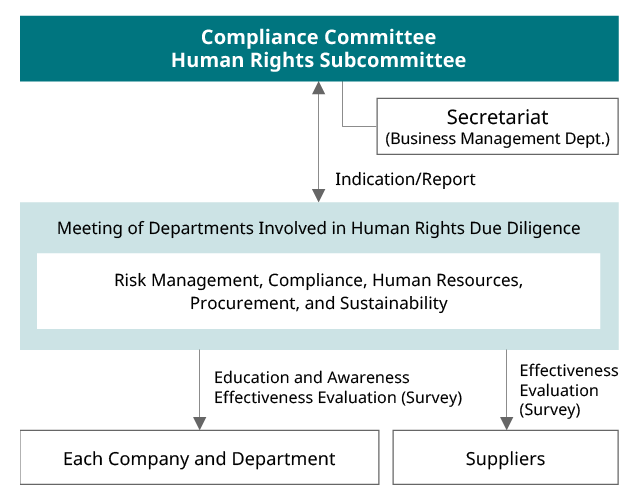
We recognize that our group's business activities affect a wide range of people, including our own employees, our business partners' employees, and residents of local communities. Based on the United Nations Guiding Principles on Business and Human Rights, our group is committed to respecting human rights by establishing mechanisms to identify, assess, prevent, mitigate, and correct the negative impacts of our business activities on human rights.
Promotion System
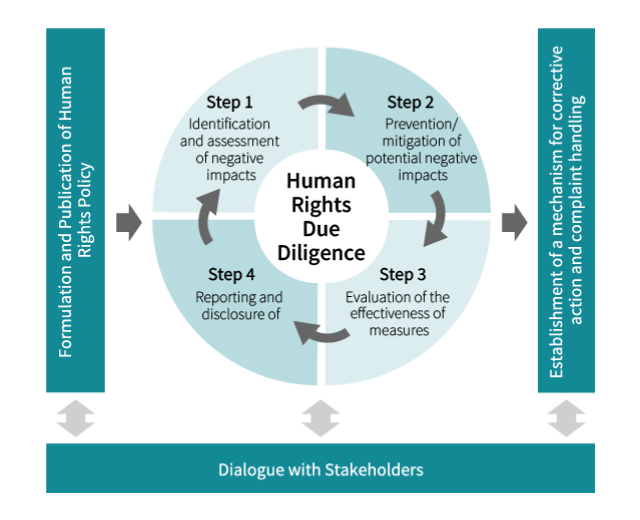
Based on our human rights policy, each department and expert committee within our group is working to address human rights issues in their respective fields.
In recent years, to address the globally accelerating issue of "business and human rights," we have been holding discussions with relevant departments (risk management, compliance, human resources, procurement, sustainability, etc.) since fiscal year 2022 to ensure the continuous implementation and improvement of the effectiveness of human rights due diligence. From fiscal year 2026, a Human Rights Subcommittee established under the Compliance Committee will continuously monitor human rights due diligence and deliberate and evaluate issues. Important matters will be reported to the Board of Directors after passing through the Management Meeting, thereby establishing an effective promotion system under the supervision of the Board of Directors.
Formulation and publication of human rights policy
Since establishing our Human Rights Policy as one of our CSR basic principles in 2020, we have reviewed its contents annually and whenever necessary.
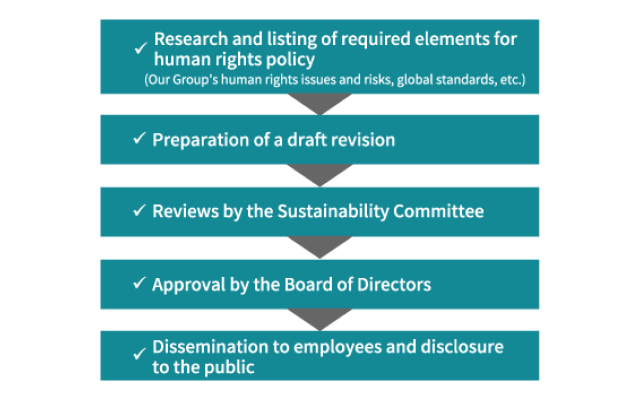
In January 2023, recognizing the increasing importance of corporate efforts to respect human rights and the need for initiatives not only within our group but throughout our entire value chain, we completely revised our Human Rights Policy to reflect international norms and other relevant standards, and added examples of human rights that we respect to the Appendix to our Human Rights Policy. In revising the policy, we sought advice from external human rights experts, held extensive discussions with departments involved in implementing human rights due diligence, obtained confirmation from the Sustainability Committee, and received approval from the Board of Directors. Furthermore, in December 2024, we revised the Appendix to our Human Rights Policy to add sections on "Rights of Indigenous Peoples and Local Communities" and "Respect for Human Rights in Security."
Human Rights Policy Revision Process
Human rights due diligence
We are working to identify, assess, prevent, and mitigate human rights risks related to our group's business activities.
In identifying human rights risks, we organized our group's main value chains and related stakeholders, and extracted generally anticipated human rights risks for each value chain. Then, we organized our group's human rights risks by referring to reports from international organizations, media databases, and benchmarks from other companies. Following this, we conducted a human rights impact assessment and mapping to identify human rights risks in priority areas.
Human Rights Risk Map
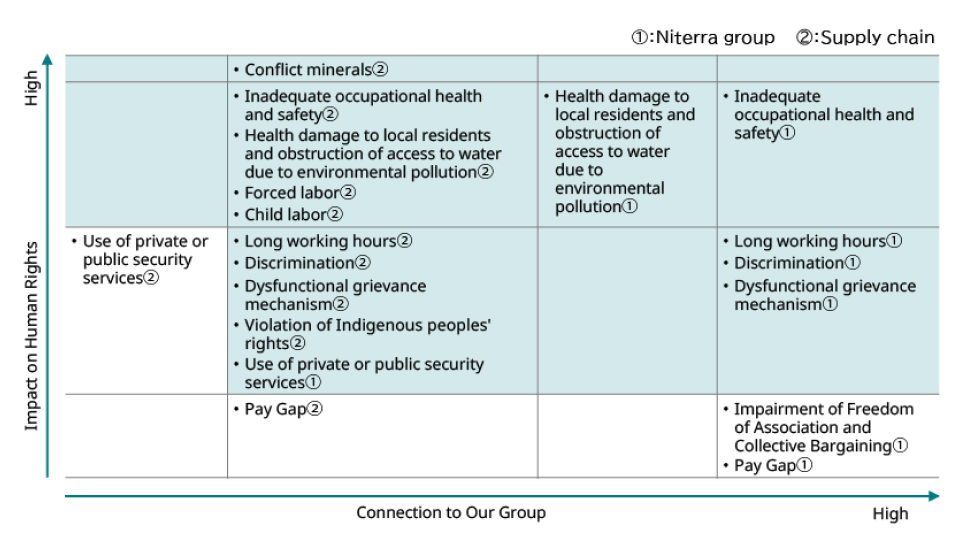
Connection with our group: Evaluated by the degree of involvement (direct, supportive, instigating) and the entities involved.
Human rights risks identified as a priority area
| Our group | Supply chain |
|---|---|
|
|
Based on these results, we are currently prioritizing human rights risks identified as key areas, focusing on our group companies and supply chains, where we have direct access to human rights, and are advancing our efforts to respect human rights.
Examples of initiatives to address human rights risks, which have been identified as a priority area within our group.
| Human rights risks | Major Initiatives |
|---|---|
| Inadequate occupational safety and health | To eliminate business interruption accidents, we are continuously implementing safety measures such as hardware improvements to equipment and thorough risk assessments. |
| Health damage to local residents due to environmental pollution, obstruction of water access | To prevent environmental accidents and pollution, each of our facilities sets its own standards for air, water quality, noise, and vibration based on legal regulations and agreements with local governments, and conducts regular measurements and maintenance. |
| Long working hours | To prevent excessive working hours, we have established work rules (such as setting fixed departure days, generally prohibiting night work and overtime exceeding 5 hours per day, and ensuring a 10-hour work interval), reduced working hours through labor-management agreements, and made discrepancies between PC logs and time clock entries visible. |
| discrimination | In our "Compliance Guidebook" and email newsletter "Compliance Communication," which are issued to employees, we provide specific examples of what is considered discrimination to raise awareness. |
| Dysfunction of the complaint handling mechanism | To improve awareness and effectiveness of internal whistleblowing systems in our overseas group companies, we are promoting awareness through our Global Compliance Guidebook. |
| Use of private and public security services | Because security requirements vary from one business location to another, security measures are implemented according to the specific circumstances of each location. |
Regarding human rights risks in the supply chain, we distribute our "Sustainability Procurement Guidelines" directly to our business partners. Furthermore, we monitor the situation through regular surveys and provide support for corrective actions through dialogue when improvements are needed. We also recognize that identified human rights risks may change due to changes in social conditions, the progress of our group's business, and the development of new business partners. Therefore, in order to enhance the effectiveness of our efforts, the departments involved in implementing human rights due diligence take the lead in regularly reviewing the risk map.
We regularly conduct surveys to confirm the status of respect for human rights within our group and supply chain.
[Our Group]
We conduct compliance awareness surveys among employees and human rights and labor surveys among group companies to identify any human rights violations or potential human rights risks.
- Employee Compliance Awareness Survey
We conduct a "Compliance Awareness Survey" targeting employees of our domestic group companies to understand compliance risks (including harassment), the level of awareness and understanding, and the organizational situation. This survey includes a free-response section, allowing employees to answer questions about their feelings regarding compliance in a way that does not identify them personally. Issues and potential human rights risks identified through the survey are fed back to each department head to promote improvement and prevent future incidents. - Human rights and labor investigations of group companies
We conduct annual surveys on human rights and labor practices at our group companies to identify potential human rights risks.
[Supply Chain]
To promote sustainability initiatives throughout our entire supply chain, we have issued and distributed our "Sustainability Procurement Guidelines" to our business partners. These guidelines include compliance requirements related to human rights, labor, and occupational health and safety.
We survey our business partners' progress every two years using a checklist and provide feedback based on the results. For business partners who require follow-up, we check their situation through visits and other means. We also provide support as needed for any improvements that may be required.
Furthermore, starting in fiscal year 2025, we have also begun conducting surveys of our group companies' business partners.
| Our group | Compliance Awareness Survey |
|
|---|---|---|
| Human Rights and Labor Survey |
|
|
| Supply chain | Survey using a checklist of sustainability procurement guidelines |
|
Based on the issues and potential human rights risks identified through our investigations, we are taking corrective measures as needed to prevent them from occurring in the first place.
As a specific example, in fiscal year 2024, it was discovered that a group company in Thailand was conducting pregnancy and infectious disease tests before employment from the perspective of ensuring safety during the workplace. Because this could lead to discrimination, the tests were abolished in accordance with international human rights standards. We have also confirmed that other group companies do not conduct similar tests.
Human rights risks cannot be completely eliminated, even with mechanisms in place such as human rights due diligence, and still exist. This is because they often stem from the limitations of these mechanisms, unforeseen circumstances, and the complexity of human rights issues, as well as the fact that human rights standards change from country to country, region to region, and era to era. To mitigate these risks, we conduct annual surveys of our company and group companies, and continue to implement a swift corrective and disclosure process for any issues that are identified.
Main initiatives for fiscal year 2025
| Human rights issues | attempt | Specific responses |
|---|---|---|
| Working conditions and equal opportunity | Review of employment contract | We have revised the content to make it easier for employees to understand working conditions before employment, adding supplementary information on the flextime system and the timing for submitting resignation notices. We have also included instructions on how to access the relevant internal regulations. |
| A comfortable work environment | Dormitory evacuation drill | To ensure the safety of our employees, we have made preparations to conduct evacuation drills in dormitories and company housing. These drills are being implemented sequentially. |
| Responsible sourcing of resources and raw materials | Awareness campaign regarding conflict minerals | To raise awareness of conflict minerals, we provided education on the subject to the relevant group companies. |
Complaint handling mechanism
We have established multiple channels to receive opinions, questions, and requests from our stakeholders, including customers, business partners, and employees.
Reports and inquiries regarding human rights from our business partners and employees are accepted through internal reporting channels established in accordance with the laws and regulations of each country. Upon receiving a report or inquiry, we have established an operational process to investigate the facts and take corrective measures as necessary, while strictly adhering to the anonymity of users and the prohibition of any detrimental treatment as stipulated in our regulations. This process includes notifying users (if they are not anonymous) of the results and confirming whether they have suffered any adverse consequences after reporting or inquiring.
[Japan]
In accordance with the Whistleblower Protection Act, we have established internal reporting systems, including a "Corporate Ethics Helpline," both internally and externally. This helpline is available in Japanese and English, accepts reports during holidays and evenings, and allows for anonymous reporting. It is accessible to our business partners and employees of our group companies. From fiscal year 2026, we have also begun offering an external helpline to job seekers as a measure against harassment during the job hunting process.
[Outside Japan]
Each company within the group has established an internal whistleblowing hotline that can be used in the local language.
Dialogue with stakeholders
We are implementing various dialogue processes to foster mutual understanding with all our stakeholders.
We regularly hold labor-management consultations with the labor union, which represents our employees, to discuss working hours and other issues, as well as to engage in dialogue with the department responsible for human rights due diligence. For our business partners, we accept consultations through consultation desks and other channels, and we discuss the cases received and take necessary corrective actions. For our customers, we disclose our group's efforts regarding human rights and labor through our response to external audits and investigations by RSCI and RBA. For residents living near our factories, we exchange opinions with their representatives, including whether there are any incidents that threaten their living environment. Furthermore, in fiscal year 2025, we conducted a dialogue between a human rights lawyer and the executive in charge.
Human rights education and awareness
Our group conducts education and training based on our human rights policy.
Compliance Guidebook
We distribute a "Compliance Guidebook" (or a "Global Compliance Guidebook" overseas) to employees working within our group.
The Compliance Guidebook is a booklet that summarizes the rules of the company and society, and is intended to help employees confirm the correct course of action as a member of the Niterra Group when they are unsure of what to do. It also sets out compliance requirements regarding human rights, such as respect for human rights and various forms of harassment prohibited by international human rights standards and national laws (harassment related to pregnancy, childbirth, childcare, and family care leave, sexual harassment including harassment against the same sex and harassment related to sexual orientation and gender identity, power harassment, moral harassment, etc.). It is used in daily awareness activities, such as reading it aloud in the workplace.
Human rights training
Our human rights training for employees of our domestic group includes video viewing and a check test on the importance of respecting human rights, our group's human rights policy, human rights due diligence, and remedies. We also conduct awareness campaigns on gender equality and LGBTQ+ issues through various training programs and email newsletters.
Basic policy on customer harassment
Our group has established a "Basic Policy on Customer Harassment" in order to build healthy relationships of trust with our customers and business partners and to protect a safe and healthy working environment for each and every employee.
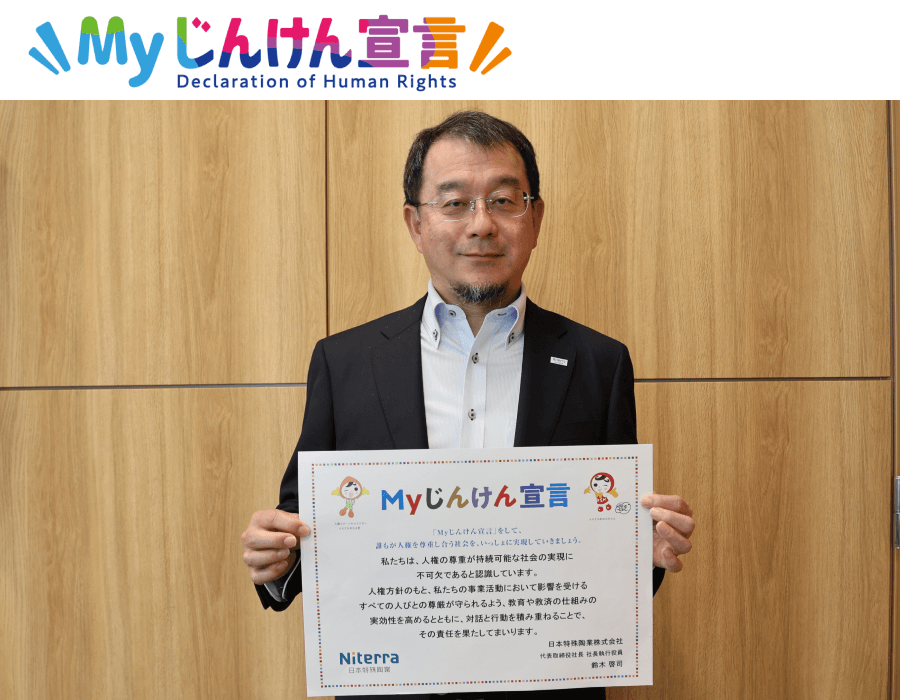
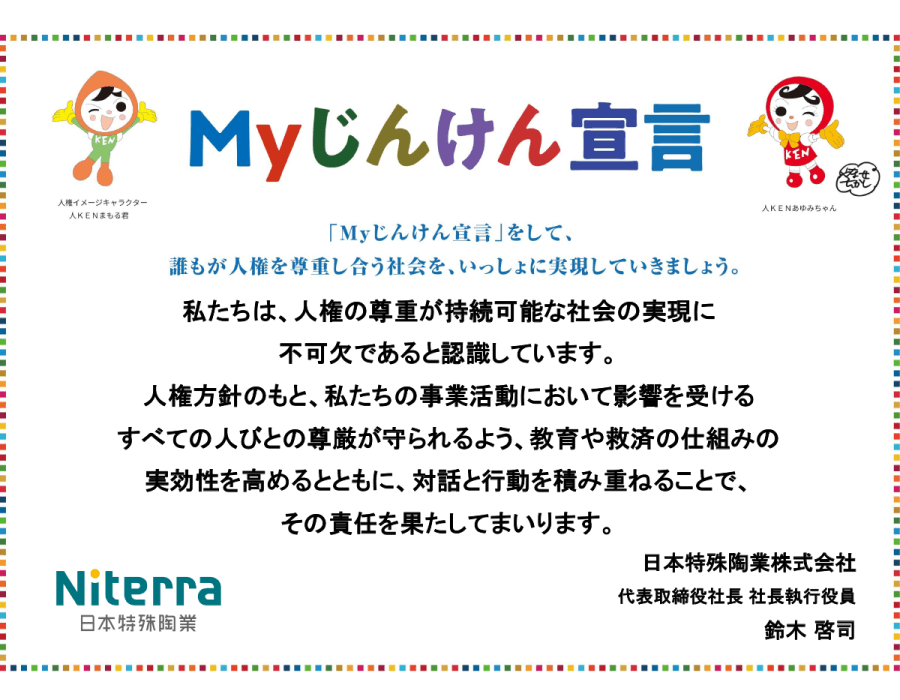
I support the Ministry of Justice's "My Human Rights Declaration" project.
In July 2021, our company endorsed the "My Human Rights Declaration" project promoted by the Ministry of Justice and published our own "My Human Rights Declaration."