



Corporate Governance
Basic Philosophy
Guided by our corporate philosophy under the slogan “With established trust and confidence inside and outside the company, we aim to contribute to the peoples of the world by creating and putting at their disposal new values for the future”, we have established, and are working to enhance, our corporate governance system to promote management aimed at increasing our corporate value over the medium to long term. Our basic view on corporate governance is to build relationships of trust with our shareholders, customers, business partners, employees, local communities, and other stakeholders through management that ensures fairness and a high degree of transparency, and to develop and operate management framework and internal control system to achieve sustainable growth through efficient and sound management.
Corporate Governance System
The Company has adopted the structure of a company with an Audit and Supervisory Committee, and individual bodies are established within that framework with the objectives of enhancing deliberation on management policies and strategies at Board of Directors meetings, strengthening supervisory functions, and further accelerating management decision-making and execution.
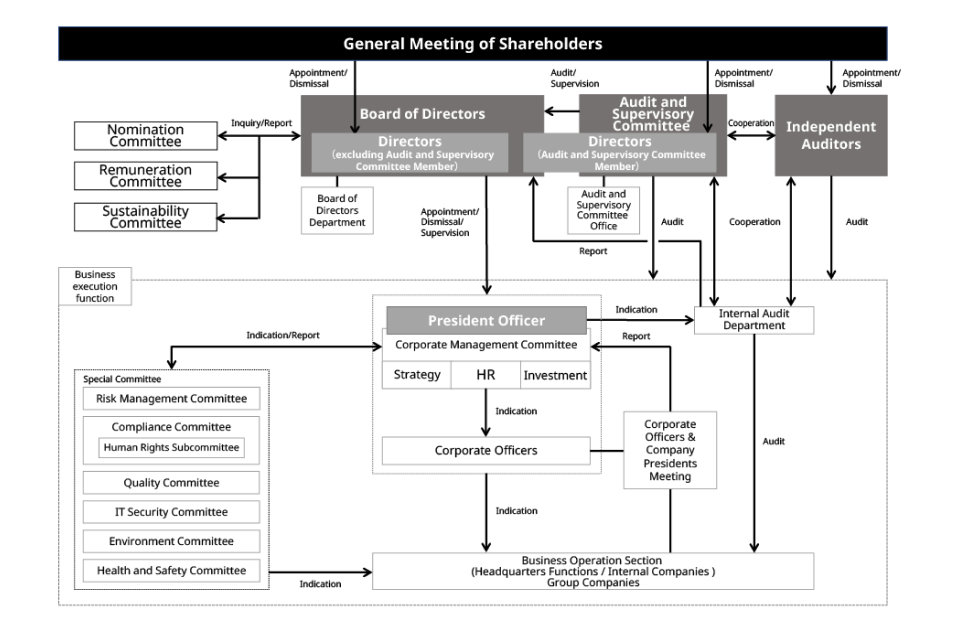
Board of Directors
The Board of Directors comprises eleven members (of which seven are Outside Directors). In principle, the Board meets once each month and at other times as necessary. As a general rule, Members of the Board are required to attend all Board of Directors meetings, and the average attendance rate in fiscal year 2025 was 100%. The Board deliberates on and makes decisions concerning matters specified in laws, regulations, and the Articles of Incorporation as well as significant matters specified in the Board of Directors Rules. Certain matters are delegated to the Representative Director and President, and the Board receives reports from the Representative Director and President and other Executive Members of the Board and supervises the status of business execution. To reinforce the supervisory functions of the Board of Directors and ensure the transparency of management, a majority of the Board is made up of Independent Outside Directors.
<Views on Balance and Diversity of Knowledge, Experience, and Skills within and Size of the Board of Directors as a Whole>
The Company’s Board of Directors believes that it is important for the Board to comprise diverse human resources with different backgrounds, including specialized knowledge and experience, in order to achieve sustainable growth and increases in corporate value over the medium to long term. The Board is made up of human resources with extensive experience, high levels of knowledge, and advanced specialization, with consideration given to gender, nationality, work experience, and age, to achieve a good balance according to the business environment at a given time.
In addition, by making up the majority of the Board of Directors with Outside Directors who have experience and specialized knowledge gained under environments that differ from the Company, the Board can strengthen its supervisory function and engage in deliberations from various perspectives in an effort to ensure transparency and objectivity in decision making.
Candidates for Members of the Board are not excluded from consideration on the basis of their race, ethnicity, nationality, country of birth, cultural background, etc.
<Skill Matrix of Members of the Board>
Based on the above views, considering the business and management system of the Group, the Board of Directors identified the knowledge and experience which it should possess from “Basic areas from the perspective of important management decision-making and business execution supervision” and “Areas that need to be particularly promoted and supervised to realize the medium-term management plan”. According to this, Members of the Board are assigned in a well-balanced manner with consideration for diversity.
*This skill matrix is as of the conclusion of the Ordinary General Meeting of Shareholders held on June 26, 2026.
| Board of Directors | |||||||||||
|---|---|---|---|---|---|---|---|---|---|---|---|
| Name | Takeshi Kawai | Keiji Suzuki | Koji Suzuki | Chiharu Takakura | Takayoshi Mimura | Hisanori Makaya | Miho Hanafusa | Kenji Isobe | Fumiko Nagatomi | Hideyo Uchiyama | Kohei Kodama |
| Position | Representative Director and Chairman of the Board | Representative Director and President |
Member of the Board, Executive Officer |
Member of the Board (Outside Director) | Member of the Board (Outside Director) | Member of the Board (Outside Director) | Member of the Board (Outside Director) | Member of the Board Standig Audit and Supervisory Committee Member |
Member of the Board (Outside Director) Audit and Supervisory Committee Member |
Member of the Board (Outside Director) Audit and Supervisory Committee Member |
Member of the Board (Outside Director) Audit and Supervisory Committee Member |
| Gender | Male | Male | Male | Female | Male | Male | Female | Male | Female | Male | Male |
| Independence | ● | ● | ● | ● | ● | ● | ● | ||||
| Years served as a Director of the Company |
11年 | 1年 | Newly appointed | 5 years (Of these, 1 year in office as an outside corporate auditor) | 3年 | 2年 | Newly appointed | 6 Years (From June 2018 to June 2022 in office, and to present position from June 2024) | 9 Years (Of these, 5 years in office as an outside corporate auditor) | 2年 | Newly appointed |
| Corporate Management | 〇 | 〇 | 〇 | 〇 | 〇 | 〇 | |||||
| Finance/Accounting | 〇 | 〇 | |||||||||
| Governance/Legal/ Risk Management |
〇 | 〇 | 〇 | 〇 | 〇 | ||||||
| Human Capital | 〇 | 〇 | 〇 | ||||||||
| Global Business | 〇 | 〇 | 〇 | 〇 | 〇 | ||||||
| Technology/R&D | 〇 | 〇 | 〇 | ||||||||
| Business Development/M&A | 〇 | 〇 | 〇 | 〇 | 〇 | ||||||
| Attendance at Board of Directors Meetings in FY 2025 | 12 / 12 | 10 / 10 *1 |
─ | 12 / 12 | 12 / 12 | 12 / 12 | ─ | 12 / 12 | 12 / 12 | 12 / 12 | ─ |
| Attendance Rate at Board of Directors Meetings in FY 2025 | 100% | 100% | ─ | 100% | 100% | 100% | ─ | 100% | 100% | 100% | ─ |
| Attendance at Audit and Supervisory Committee Meetings in FY 2025 | ─ | ─ | ─ | ─ | ─ | ─ | ─ | 12 / 12 | 12 / 12 | 12 / 12 | ─ |
| Attendance Rate at Audit and Supervisory Committee Meetings in FY 2025 | ─ | ─ | ─ | ─ | ─ | ─ | ─ | 100% | 100% | 100% | ─ |
| Number of Shares Held | 38,242株 | 9,459株 | 15,700株 | 1,762株 | 1,708株 | 1,052株 | 0株 | 21,924株 | 4,040株 | 163株 | 0株 |
*1 As he was appointed at the Ordinary General Meeting of Shareholders held on 25 June 2025, his attendance covers the 10 Board of Directors meetings held since his appointment.
<Reason for Selection of Skills>
| Skills | Reason for selection |
|---|---|
| Corporate Management | As the automobile industry enters a period of great change, the Group is aiming for an optimal business portfolio structure. As such, corporate management skills are required in order for the Board of Directors to oversee strong decision-making by management and decide on management policies that balance enhancing corporate value with solving social issues from a medium- and long-term perspective. |
| Finance/Accounting | As we promote medium- and long-term profit growth and strengthened shareholder returns, finance and accounting skills are required in order for the Board of Directors to oversee the sound implementation of the financial reporting system and the formulation and implementation of financial strategies for realizing growth investments that are balanced with financial soundness and investments that will strengthen the management infrastructure. |
| Governance/Legal/ Risk Management |
As we aim to further enhance governance, skills in the areas of governance, legal, and risk management are required in order for the Board of Directors to oversee the establishment and implementation of governance and risk management systems that promote compliance and adequately respond to risks that hinder business operations. |
| Human Capital | As we aim to develop human resources that embody the “Niterra Way,” human capital skills are required in order for the Board of Directors to oversee the formulation and implementation of human resources strategies focused on promoting human capital investment efforts, including development of human resources, optimization of personnel placement, and organizational and system reforms. |
| Global Business | As we expand our businesses in the global market and utilize global production and sales systems to enter new business areas, global business skills are required in order for the Board of Directors to oversee businesses from a multifaceted perspective with an understanding of strategies and risks in the global market. |
| Technology/R&D | As we aim to expand businesses centered on ceramics technology and acquire new core competencies, technological development and R&D are important business activities. As such, technology and R&D skills are required in order for the Board of Directors to oversee the identification of technology and R&D focus areas and the allocation of management resources to achieve them. |
| Business Development/M&A | As we aim for growth and new business creation through business development utilizing our core assets and the achievement of synergy with other companies through M&A, etc., business development and M&A skills are required in order for the Board of Directors to oversee the appropriate allocation of management resources, business continuity decisions, and M&A aligned with the medium- and long-term strategies. |
<Board of Directors Dept.>
The Company has established the Board of Directors Department as a dedicated organization to support the operation of the Board of Directors. The purpose is to enhance the content of deliberations at the Board of Directors meetings, strengthen supervisory functions, and improve support and information provision to Outside Directors who constitute the majority of the Board of Directors. The Board of Directors Department supports the smooth operation and enhanced effectiveness of the Board of Directors by organizing and selecting Board meeting topics, planning annual schedules, coordinating with related departments, and conducting pre-meeting briefings and orientation for Outside Directors at the time of their appointment, as well as managing the effectiveness evaluation of the Board of Directors. In addition, the Board of Directors Department also serves as the secretariat for the Nomination Committee, Remuneration Committee, and Sustainability Committee, supporting the operation of each committee.
Audit and Supervisory Committee
The Audit and Supervisory Committee comprises four members (of which three are Outside Members) and as an independent body entrusted by the shareholders, audits and supervises the execution of business by the Members of the Board. Standing Audit and Supervisory Committee Members are selected from the perspective of maintaining the audit environment, gathering information from within the Company, and monitoring and verifying the establishment and operation of internal control systems on a daily basis and sharing such information with other members to ensure the effectiveness of organizational audits. The Audit and Supervisory Committee also confirms the appropriateness and suitability of the nominations and remuneration of Members of the Board (excluding Members of the Board who are Audit and Supervisory Committee Members) by attending Nomination Committee and Remuneration Committee meetings and receiving explanations from the Representative Directors and forms opinions on these matters.
<Audit and Supervisory Committee Dept.>
To support the execution of duties by the Audit and Supervisory Committee, the Audit and Supervisory Committee Department has been established, and dedicated employees are assigned to the department. These employees work under the supervision and direction of the Audit and Supervisory Committee, and their independence in relation to supervision and direction from Members of the Board (excluding Members of the Board who are also Audit and Supervisory Committee Members), Corporate Officers, and employees is ensured. In addition, transfers, personnel evaluations, etc. require the prior consent of the Audit and Supervisory Committee.
Nomination Committee
To ensure rationality and transparency and conduct efficient and fulfilling discussion with regard to nomination of Members of the Board and Corporate Officers, a Nomination Committee has been established as an advisory body to the Board of Directors. To ensure its independence, the majority of the members of the committee are Independent Outside Directors, the committee comprising Members of the Board who are appointed by the Board of Directors. In addition, Members of the Board who are Audit and Supervisory Committee Members also attend the committee as observers.
Based on the Board of Directors’ request for opinion, the Nomination Committee deliberates on matters including proposals on the appointment of Members of the Board to be submitted to the General Meeting of Shareholders, the appointment and dismissal of Representative Directors and Members of the Board with a concurrent position, the appointment and dismissal of Corporate Officers, and then delivers its opinions to the Board of Directors.
Remuneration Committee
To ensure rationality and transparency and conduct efficient and fulfilling discussion with regard to determination of remuneration of Members of the Board and Corporate Officers, a Remuneration Committee has been established as an advisory body to the Board of Directors. To ensure its independence, the majority of the members of the committee are Independent Outside Directors, the committee comprising Members of the Board who are appointed by the Board of Directors. In addition, Members of the Board who are Audit and Supervisory Committee Members also attend the committee as observers.
Based on the Board of Directors’ request for opinion, the Remuneration Committee deliberates on matters related to remuneration of Members of the Board (excluding Members of the Board who are Audit and Supervisory Committee Members) and Corporate Officers (excluding employment-type Corporate Officers), including the appropriateness of policies, procedures, and systems, as well as the appropriateness of the proposed remuneration of each Member of the Board (excluding Members of the Board who are Audit and Supervisory Committee Members) and each Corporate Officer (excluding employment-type Corporate Officers), and delivers its opinions to the Board of Directors.
Sustainability Committee
To ensure our Group's sustainable growth alongside society, we have established a Sustainability Committee as an advisory body to the Board of Directors. With an Outside Director serving as Chairperson to emphasize external perspectives, we have established a supervisory framework. The Sustainability Committee deliberates on matters concerning medium- to long-term sustainability management policies and submits its recommendations accordingly to the Board of Directors.
Members of the Committees
| Member of the Board | Members of the Board, Audit and Supervisory Committee Members | |||||||||
|---|---|---|---|---|---|---|---|---|---|---|
| Name | Takeshi Kawai | Keiji Suzuki | Chiharu Takakura | Takayoshi Mimura | Hisanori Makaya | Miho Hanafusa | Kenji Isobe | Fumiko Nagatomi | Hideyo Uchiyama | Kohei Kodama |
| Independence | ● | ● | ● | ● | ● | ● | ● | |||
| Nomination Committee | 〇 | 〇 | - | 〇 | 〇 | 〇 | - | Attends the meeting | - | - |
| Remuneration Committee | 〇 | - | 〇 | - | 〇 | - | - | - | Attends the meeting | - |
| Sustainability Committee | 〇 | 〇 | 〇 | - | - | 〇 | - | - | - | 〇 |
* In addition to the "〇" directors, the Sustainability Committee member is Ms. Chikako Miyata, Advisor of ANA HOLDINGS INC., in charge of SDGs, as an outside expert.
Corporate Management Committee
The Corporate Management Committee, comprising Representative Directors, the Vice President Officer, and some Corporate Officers, has been established to make decisions on and supervise important matters relating to business execution in accordance with the basic management policies determined by the Board of Directors, to discuss and understand in advance management issues to be addressed and risks that the Group is facing, and to promptly respond to changes in the management environment. The Corporate Management Committee addresses management strategy and other important matters relating to overall management and also focuses its deliberations on important human resource strategies and measures relating to the assignment and development of human resources as well as significant investments including capital expenditures, equity contributions, acquisitions, and capital tie-ups.
Corporate Officers and Company Presidents Meeting
The Company adopts the Corporate Officer framework, the objective of which is to expedite execution of business operations based on policies determined by the Board of Directors and clarify responsibilities for the results. The Corporate Officers are elected by the Board of Directors, and meet monthly at the Corporate Officers and Company Presidents Meeting to report on the status of business execution for cross-divisional sharing and exchange of information. Members of the Board who are not Corporate Officers may also attend the Corporate Officers and Company Presidents Meeting as needed, to provide supervision and advice on business execution.
Cooperation among Audit and Supervisory Committee, Independent Auditor and Internal Audit Departments
The Company strives to improve the effectiveness of audits by having the Audit and Supervisory Committee, independent auditor, and Internal Audit Department meet regularly and as necessary to exchange information on audit policies, audit plans, audit implementation status, accounting system revisions, etc. and to work in close collaboration with one another.
The Audit and Supervisory Committee and Internal Audit Department meet regularly and as necessary to provide direct reports and exchange information on audit policies, audit plans, audit implementation status, and other matters and to work in close collaboration with one another.
In addition, Audit and Supervisory Committee Members attend audits conducted by the Internal Audit Department when necessary, and the Internal Audit Department conducts investigations and makes reports as requested by the Audit and Supervisory Committee, improving the quality of audits by both bodies.
Evaluation of the Effectiveness of the Board of Directors
The Company conducts an evaluation on the effectiveness of the Board of Directors once a year. A summary of the evaluation results for the fiscal year 2025 is provided below.
<1. Method of Evaluation>
The Company conducted a questionnaire survey and individual interviews with the Members of the Board covering evaluation items that included the composition and operation of the Board of Directors, deliberations on management strategies and other matters, and the Board’s oversight of business execution during the fiscal year 2025. Based on the results of the survey and interviews and other relevant information, the Company evaluated the effectiveness of the Board of Directors. The evaluation framework was designed with advice from an Outside Director. In addition, the distribution, collection, and tabulation of the questionnaires, as well as the conduct of the individual interviews, were outsourced to an external organization.
<2. Overview of evaluation results>
As a result, we confirmed that the Company’s Board of Directors is sufficiently effective and that effective measures are implemented with respect to the following matters in particular.
- The Board of Directors is composed of members who collectively possess the knowledge, skills, experience, and diversity necessary to fulfill its roles and functions, and engages in active and constructive discussions in a culture of mutual respect and open communication. Furthermore, in order to focus on deliberation of important matters, including medium- to long-term management strategies, the Board of Directors appropriately and sufficiently delegates decision-making authority to the executive team with respect to matters such as individual business execution decisions.
- The Board of Directors supports appropriate risk-taking by the management team in pursuing the Company’s value creation story, encouraging it to take calculated risks and act proactively to seize new earnings opportunities and enhance the Company’s earning capacity amid uncertainty.
- The Board of Directors has confirmed that objective, timely and transparent procedures and evaluation criteria have been properly established for the appointment and dismissal of the President and other senior executives. The Board has also confirmed that discussions are conducted to ensure that incentive remuneration for the management team is aligned with management strategy and business plans and provides appropriate incentives.
- The Board of Directors implements appropriate improvement measures regarding the key issues identified through evaluation of the effectiveness of the Board of Directors, and strives to enhance its effectiveness.
Among the issues identified in the effectiveness evaluation for fiscal year 2024, the issue of “improving the efficiency of Board meeting operation, thereby further facilitating discussions” was addressed by enhancing the mechanisms to facilitate more active discussions. These include sharing of the Board’s annual agenda schedule to clarify key matters and items requiring monitoring, as well as conducting pre-meeting briefing sessions for Outside Directors to provide them with sufficient information and organize discussion points in advance of the Board meetings.
With respect to “strengthening of the Board’s monitoring of responses to changes in the business environment and deeper discussions on business strategies,” a framework was introduced under which reports on important matters and businesses requiring close attention were incorporated into the Board’s annual agenda plan, in addition to quarterly reports provided by Executive Members of the Board. This framework enables the Board to gain a detailed understanding of the progress of each business at appropriate times and to engage in timely and in-depth discussions.
As a result of the effectiveness evaluation for the fiscal year under review, the Board identified the steady implementation of the measures developed and introduced during the year, as mentioned above, as an area for further enhancing its effectiveness. The Board also recognized the need to secure sufficient time for Board deliberations, as well as to expand discussions beyond individual business execution matters and adopt a broader perspective in deliberations on long-term management strategies, capital policy, and investments in human capital. Going forward, the Company will continue its efforts to maintain and further enhance the effectiveness of the Board of Directors by addressing these issues.
Role and Independence of Outside Directors
To enhance the supervisory function of the Board of Directors and to ensure the transparency and objectivity of decision-making through discussions from multifaceted viewpoints, Outside Directors make up the majority of the Board of Directors, which comprises diverse individuals who have abundant experience, tremendous insight and a high degree of professionalism. We appoint all the Independent Outside Directors as independent officers and notify the Tokyo Stock Exchange and the Nagoya Stock Exchange of their appointment. In order to ensure that candidates have neither special relationships with the management team and major shareholders nor conflicts of interest with general shareholders, we designate those who meet all the following as independent officers: our own criteria for the appointment of independent officers; the requirements for independent officers set by the Companies Act; and the rules and regulations stipulated by the financial instruments exchanges.
Outside Directors attend the Board of Directors meetings and non-statutory advisory bodies to demonstrate their supervisory function by becoming involved in the important decision-making of the company from an independent standpoint, while providing advice from an overall perspective based on their abundant experience and insight when formulating and confirming the progress of medium- to long-term management policies at the Board of Directors meetings. Outside Directors who are Audit and Supervisory Committee Members serve as a supervisory and auditing function based on their independence and expert knowledge.
Succession Plan
To achieve sustained growth and improve mid- to long-term corporate value for our Group, we are working on the formulation and implementation of a succession plan, investing a sufficient amount of time and resources to ensure that the optimal candidate with the right qualities to lead the future management of our Group can be appointed as President.
Specific Involvement by the Board of Directors
Although our succession plan is formulated and implemented under the leadership of the Chairman of the Board and the President, to ensure its objectivity and transparency, we continuously report on the formulation and implementation status to the Nomination Committee, where Independent Outside Directors comprise the majority, while also reflecting advice from Outside Directors into our measures as appropriate.
Details of Human Capital Identification and Development Measures
At the Niterra Group, to cultivate talent who will lead the next generation of management, we implement various next-generation management talent development programs, such as the global selection program HAGI and the domestic selection program Nittoku Business School for selected domestic talent. Additionally, we are promoting the development of local leadership that contributes to management within each country and region via our unique selective training programs.
Training for Officers
We provide the Members of the Board with sufficient assistance to fulfill their expected roles and responsibilities where applicable. For the Internal Directors, we encourage them to take external seminars to acquire additional knowledge to meet their obligations, while the Internal Directors and Corporate Officers are required to attend an executive training session to share the managerial issues and seek out the solution. In order for the Outside Directors to deepen understanding of the Group, each department explains the businesses and operations in addition to providing them with opportunities to visit major sites of the businesses.
Members of the Board who are Audit and Supervisory Committee Members periodically take external sessions to gain understanding of what roles the Audit and Supervisory Committee Members fulfill, the audit methods, the relevant laws and regulations, and financial accounting knowledge required for the accounting audit.
Remuneration for Director
Remuneration of Members of the Board (excluding Audit and Supervisory Committee Members and Outside Directors) and Corporate Officers comprises base remuneration paid in cash, bonuses linked to the degree of achievement of the Company’s performance over the course of a single year and other factors, and performance-linked, stock-based remuneration that is determined according to rank and the degree of achievement of performance targets set forth in the medium-term management plan and so on. This structure is intended to raise awareness regarding the contribution to improving corporate performance and maximizing corporate value over the medium- to long-term and is based on a fundamental policy of Members of the Board and Corporate Officers sharing interests with shareholders through ownership of Company shares.
Remuneration of Members of the Board who are Audit and Supervisory Committee Members and Outside Directors comprises only fixed remuneration.
Fixed Remuneration
Fixed remuneration is determined based on a comprehensive assessment that takes into account the position and responsibilities, as well as the standards of other companies, the Company's performance, and the level of employee salaries.
Policy on the Payment of Bonus
Bonuses are determined by multiplying the base amount for each position by coefficients corresponding to (i) the consolidated single-year degree of achievement of the targets set for each performance indicator that reflect the results of sales activities and (ii) the degree of achievement of non-financial indicators that reflect the results of efforts aimed at achieving sustainable growth and improving corporate value. Bonuses are paid in cash at a specified time every year.
The base amount for each position, the performance indicators used for evaluation of the degree of achievement of targets, and the target values for each indicator are determined by the Board of Directors, with due respect for the recommendations of the Remuneration Committee, at the time of formulation of the medium-term management plan in order to ensure consistency with the said plan, and are appropriately reviewed in response to environmental changes.
Performance-linked Stock-based Remuneration
We introduced a performance-linked stock-based remuneration program that is highly linked to the Company's performance and offers high transparency and objectivity for Members of the Board (excluding Members of the Board who are Audit and Supervisory Committee Members and Outside Directors) and Corporate Officers (excluding employment-type Corporate Officers) to have them share interests with shareholders, so as to incentivize them to contribute to the improvement of the Company’s medium- to long-term performance and to increasing corporate value.
Under this program, an officer remuneration Board Incentive Plan (BIP) trust is used, and points are awarded according to rank, degree of achievement of the Medium-Term Management Plan, and other factors in accordance with a calculation method specified in the Share Delivery Rules established by the Board of Directors following deliberation with the Remuneration Committee. Following expiration of the subject period of this program, Members of the Board will be delivered or granted Company shares or monies equivalent to the conversion value of those shares based on the total number of points awarded.
The degree of achievement of performance targets, etc. is set based on medium-term performance indicators, shareholder value indicators, and non-financial indicators. The medium-term performance indicators are consolidated revenue and profit attributable to owners of the parent which are the targets of the Medium-Term Management Plan. The shareholder value indicator is based on relative TSR (total shareholder return), which is calculated based on the results of comparison between the Company’s TSR during the period of the Medium-Term Management Plan and the TSR of the peer group for the same period to strengthen awareness of the need to increase shareholder value. The non-financial performance indicator uses employee engagement to evaluate achievements of human capital management initiatives aimed at sustainable growth of the Group. The various indicators used such as to evaluate the degree of achievement of performance targets are determined by the Board of Directors, ensuring that they are set in alignment with the Medium-Term Management Plan and by giving due respect to the reports of the Remuneration Committee. As an element of the performance-linked stock-based remuneration, etc., the indicators are proposed at the General Meeting of Shareholders for resolution.
Remuneration and Bonus Paid to Members of the Board in fiscal year 2025
| Total remuneration (million yen) |
Total remuneration by type (million yen) |
Number of recipients ((persons) |
|||
|---|---|---|---|---|---|
| Fixed Remuneration | Bonus | Performance-linked, stock-based remuneration | |||
| Members of the Board (excluding Audit and Supervisory Committee Members) |
490 | 258 | 164 | 67 | 8 |
| (Outside Directors) | (64) | (64) | (-) | (-) | (4) |
| Members of the Board, Audit and Supervisory Committee Members | 86 | 86 | - | - | 4 |
| (Outside Directors) | (46) | (46) | (3) | ||
*1: The following limits are set on the remuneration paid to Members of the Board (excluding Members of the Board who are Audit and Supervisory Committee Members) according to the resolution made at the 125th General Meeting of Shareholders held on June 25, 2025.
- 47 million yen or below per month (Of which, the monthly amount for Outside Directors is 13 million yen or below)
- 260 million yen or below per year
Separately from the above, a performance-linked stock compensation plan was established by resolution of the 125th Ordinary General Meeting of Shareholders held on June 25, 2025, for Members of the Board of the Company (excluding Members of the Board who are Audit and Supervisory Committee members and Outside Directors) and Corporate Officers (excluding employment-type Corporate Officers), for a maximum amount of 3,400 million yen over a period of five fiscal years from the fiscal year ending March 31, 2026 to the fiscal year ending March 31, 2030.
*2: The following limits are set on remuneration paid to Members of the Board who are Audit and Supervisory Committee Members according to the resolution made at the 122th General Meeting of Shareholders held on June 24, 2022.
- 10 million yen or below per month
- 10 million yen or below per year
*3: “Bonus” corresponds to “performance-linked remuneration, etc.”, and “performance-linked, stock-based remuneration, etc.” corresponds to “performance-linked remuneration, etc.” and “non-monetary remuneration, etc.” The total amounts of "bonuses" and "performance-linked, stock-based remuneration" are the amounts recorded as expenses during the current fiscal year.
*4: The above includes remuneration for one Member of the Board (excluding Members of the Board who are Audit and Supervisory Committee Members) who retired at the conclusion of the 125th Annual General Meeting of Shareholders.
For details of the calculation method, please see the Annual Securities Report.
Enhancement of Group Governance
The Company have Corporate Officers who were locally recruited at its regional headquarters (RHQs) for the Americas and EMEA in order to ensure that speedy and accurate managerial decisions are made at bases closer to the markets they serve in view of the Company’s globally expanding business environment. We have also formed unique governance teams at the RHQs to build an optimal decentralized system on a group-wide basis and enhance corporate governance as the entire Group.
Moreover, the Group Internal Audit Headquarters is in place as an organization that audits the effectiveness of the Group’s governance as an entity that is separate from its business execution. This organization formulates and implements measures to carry out audits on the management of Group companies and RHQs and on the core business operations of each department. It also formulates and implements measures to enhance internal control across the Group and thus plays an important role for the enhancement of the Group’s governance.