



Information Disclosure Based on TNFD Recommendations
Currently, biodiversity loss is progressing at an unprecedented rate worldwide, leading to a wide range of social challenges through the decline of ecosystem services. Our group has made addressing these and other social challenges one of its top management priorities. Furthermore, in our medium- to long-term environmental vision, "Eco Vision 2030," we have analyzed the impact of our business and products on society and on our own company, and have identified and are addressing 13 issues with a significant impact.
Towards realizing a nature-positive society, we will further evolve our efforts by incorporating the principles of the TNFD recommendations.
General requirements
The TNFD recommendations require the inclusion of six "general requirements" as common assumptions and fundamental understandings throughout the entire disclosure report. Our group's position on these requirements is explained below.
1. Application of Materiality
Our group adopts a "double materiality" perspective when identifying priority management issues (materiality). In evaluating nature-related issues, we also applied "double materiality," which involves evaluating both the impact our company has on nature (impact) and the financial impact our company receives.
2. Scope of Disclosure
In this assessment, we identified nature-related risks for representative products in the value chains of our three main businesses (automotive, ceramics, and new businesses). This ensures that the scope of disclosure covers key areas of our business activities. The scope of disclosure based on this assessment applies to all areas of this report, including the "general requirements," governance, strategy, risk and impact management, and metrics and targets. We will continue to periodically review and update the scope of this assessment and the risks and opportunities identified in line with the progress of our portfolio optimization efforts.
| Segment | Typical products | Upstream | Direct operation | Downstream |
|---|---|---|---|---|
| Automotive components | Spark plug, oxygen sensor | Industry average risk of main raw materials | Manufacturing | Logistics, product use |
| Ceramic business | Piezoelectric ceramics, products for semiconductor manufacturing equipment | Industry average risk of main raw materials | Manufacturing | Logistics |
| New business | Balls for bearings, solid oxide fuel cells (SOFCs) | Industry average risk of raw materials | Manufacturing | Logistics |
3. Location of nature-related issues
In this disclosure, we have conducted evaluations of our group's production sites (15 domestic and 16 overseas). We will also proceed with the evaluation of Niterra Materials, which joined the group in June 2025, in due course.
4. Integration with other sustainability-related disclosures
In this disclosure, our group will disclose information regarding nature-related issues in accordance with the TNFD recommendations. Meanwhile, we consider climate change to be one of our important management issues and have already made disclosures based on the TCFD recommendations. Recognizing that nature-related issues and climate change are inseparable and important environmental issues, our 2026 Integrated Report will include integrated disclosures of climate change and nature-related issues.
5. Considered timeframe
The time axis was defined as follows, in accordance with the time axis set in TCFD.
- Short term: Until around 2027
- Medium term: Until around 2030, aligned with the target year of the long-term management plan.
- Long term: Up to around 2040, aligned with the vision outlined in the long-term management plan.
6. Engagement with indigenous peoples, local communities, and affected stakeholders in identifying and assessing nature-related issues.
Our group recognizes that our business activities impact nature, and that this process involves indigenous peoples, local communities, and other affected stakeholders. To conduct meaningful engagement in identifying and assessing nature-related issues, we conducted a survey of our global production sites regarding their proximity to areas where nature, biodiversity, and ecosystem services are important to indigenous peoples and local communities.
Our group promotes human rights due diligence for stakeholders under our human rights policy. Regarding our response to stakeholders in nature-related issues, we will also adhere to this fundamental stance of respecting human rights, striving to understand the situation as needed and promote sincere engagement.
Governance
Recognizing that all of our group's business activities depend on and impact the environment and the biodiversity that underlies it, we promote environmental activities under our environmental policy and biodiversity guidelines. We have established a Central Environmental Committee, chaired by an executive appointed by the President, which holds regular meetings twice a year and extraordinary meetings as needed. The Central Environmental Committee reviews the progress of Eco Vision 2030 and the group's environmental issues, and strives for continuous improvement. Important decisions made by the Central Environmental Committee are reported to the Board of Directors through the Management Meeting, which deliberates, decides on, and supervises important matters in business execution, and are overseen by the Board of Directors.
Furthermore, we recognize that our group's business activities and biodiversity conservation efforts may have an impact on the human rights of local communities and indigenous peoples. Based on our human rights policy, each department and expert committee within our group promotes responses to human rights issues in their respective areas. Regarding our efforts to respect human rights, the Human Rights Subcommittee, established under the Compliance Committee, conducts continuous monitoring of human rights due diligence and deliberates and evaluates issues. Important matters are reported to and submitted to the Board of Directors after passing through the Management Meeting, thereby establishing an effective promotion system under the supervision of the Board of Directors.
Strategy
Dependence and impact through our group's business
To understand the overall picture of our group's dependence on and impact of nature-related factors in our business activities, we conducted an assessment of the entire value chain using "ENCORE," a global assessment tool for nature-related factors. For upstream operations, we analyzed the industry and sector divisions to which our main raw materials belong, and for direct operations, we analyzed our unique manufacturing processes as a manufacturing company, linking them to the assessment items of ENCORE. For downstream operations, in addition to the assessment of the logistics (transportation) sector, we also analyzed the dependence and impact at the point of use of the final product in which our parts are installed in our automotive-related business, which accounts for 80% of our group's sales. We organized these results into a heat map to identify items with high dependence and impact in our group's value chain (corresponding to a dependence level of "High (H)" and impact levels of "Very High (VH)" and "High (H)").
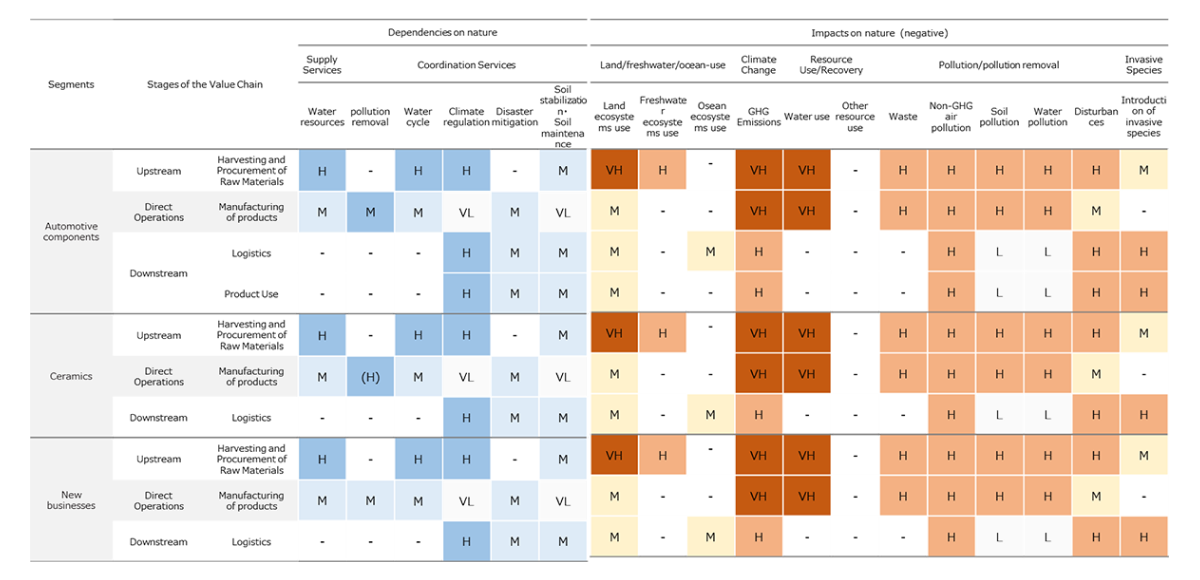
* For details on the heatmap, please see Appendix 1.
Table: Dependencies and Impacts in the Value Chain
| Dependence on nature | Upstream | • Dependence on water resource supply services, water cycle and climate regulation services, for the mining, refining, and processing of minerals that are raw materials for ceramics and steel. |
| Downstream | • Dependence on climate control services during logistics and the use of final products (automobiles, etc.) that incorporate our parts. | |
| Impact on nature | Upstream | • Land use during the mining of minerals that are raw materials for ceramics, steel, etc. • GHG emissions, water use, waste, and air, soil, and water pollution during the mining, refining, and processing of minerals that are raw materials for ceramics, steel, etc. |
| Direct operation | • GHG emissions during product manufacturing within our group, water resource use, waste, air, water, and soil pollution | |
| Downstream | • GHG emissions, air pollution, and environmental disturbance during product transportation by automobiles, ships, etc. |
Identified risks and opportunities and their impact assessment
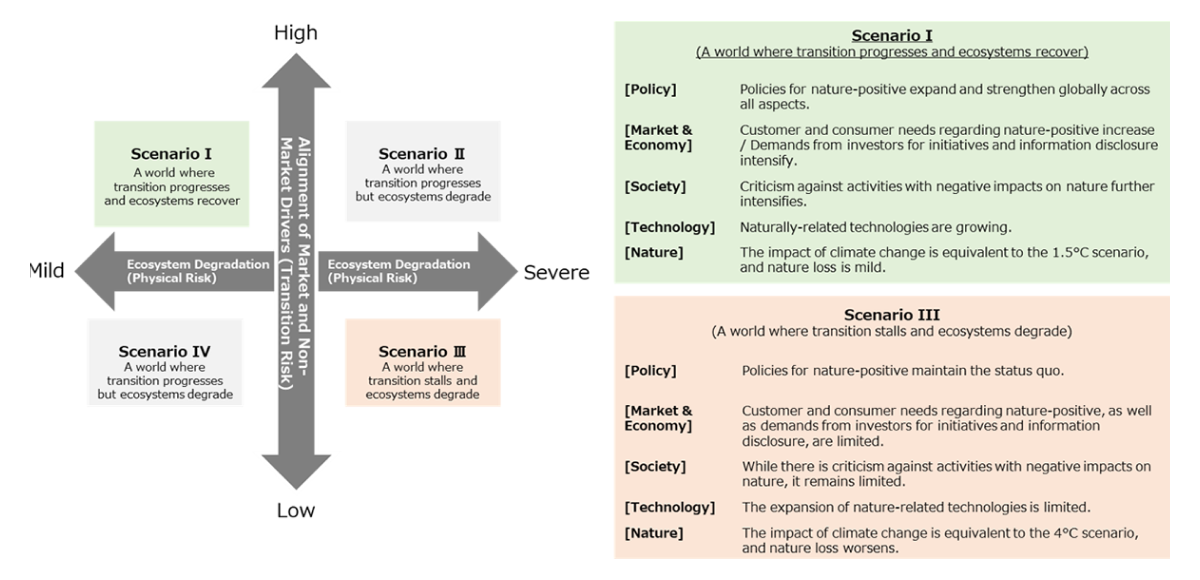
Based on the results of the dependency and impact assessments, we extracted risks and opportunities related to natural capital. For risks, we used scenarios to organize their impact and likelihood of occurrence. We evaluated two of the four qualitative scenarios based on the four-quadrant matrix recommended by the TNFD recommendations: "Scenario I: A world where the transition progresses and ecosystems recover" and "Scenario III: A world where the transition stalls and ecosystems degrade," and identified risks of moderate to high levels.
(1) Scenario analysis process
Following the process proposed in the TNFD Scenario Analysis Guidance, we used four qualitative scenarios based on two axes: ecosystem degradation (physical risk) and alignment of market/non-market drivers (transition risk). Next, in order to create scenarios that would be useful for examining risks and opportunities, we specified the direction of changes in the external environmental factors surrounding our group under each scenario. Then, we examined the nature-related risks and opportunities in our group's business under the assumed external environment.
(2) Risks identified and prioritized by our group (evaluation results)
Scenario I: A world where the transition progresses and ecosystems recover.
| Classification | Related dependence on nature and impact | Direct operations/Upstream | Risk details | Impact level *1 | Probability /Urgency *2 | Priority *3 | Support ※4 | |
|---|---|---|---|---|---|---|---|---|
| Transfer | Policy | [Impact] Pollution/Decontamination | Direct operation | ● Strengthening of regulations and ordinances concerning wastewater ● The introduction of a closed system as a countermeasure against wastewater restrictions, and the resulting increase in operating costs. |
Medium | Medium | 4 | • Water quality management at wastewater treatment facilities at each location, at a level higher than the regulatory limit. Niterra implements a closed system in India. |
| [Impact] Resource utilization/recovery | Direct operation | ● The need to comply with regulations and ordinances, such as restrictions on the use of virgin materials and mandatory use of recycled materials (including mineral resources). ● Difficulty in procuring raw materials and price increases due to regulations |
Medium | Medium | 4 | • Regarding raw material procurement risks associated with restrictions on the use of virgin materials and mandatory use of recycled materials, a detailed assessment roadmap will be formulated in FY2026, and the assessment will be started in stages. | ||
| [Impact] Use of terrestrial ecosystems, use of water resources, air, water, and soil pollution, waste (mineral production sites) | Upstream | ● Reduced mineral supply due to stricter regulations on environmental management during mining, and rising mineral prices due to increased production costs. | Large | Medium | 3 | • We are currently developing a roadmap for a detailed assessment of regulatory risks related to ecosystems and nature reserves surrounding the mine. | ||
| [Dependence] Water resource supply [Impact] Resource utilization/recovery |
Upstream | ● Reduced mineral supply due to increased water procurement costs resulting from water restrictions, and rising mineral prices due to increased production costs. | Large | Medium | 3 | • Regarding the risk of operational shutdowns due to water stress (water shortage) at our suppliers, we will formulate a detailed assessment roadmap in FY2026 and begin the assessment in stages. | ||
| [Impact] Use of terrestrial ecosystems, use of water resources, air, water, and soil pollution, waste (mineral production sites) | Upstream | ● Shortages in raw material supply and price increases due to the introduction of restrictions on harvesting and mining (including land alteration) for nature conservation. | Medium | Medium | 4 | • Regarding regulatory risks related to ecosystems and nature reserves surrounding mines, a detailed assessment roadmap will be formulated in FY2026, and assessments will be initiated in stages. | ||
| [Dependence] Water resource supply [Impact] Resource utilization/recovery |
Upstream | ● Shortages in raw material supply and price increases due to the introduction of stricter regulations and ordinances regarding the extraction of water resources such as surface water and groundwater. | Medium | Medium | 4 | • Regarding procurement risks associated with water resource dependence in the supply chain, a detailed assessment roadmap will be formulated in FY2026, and the assessment will be started in stages. | ||
Scenario III: A world where the transition stalls and ecosystems deteriorate.
| Classification | Related dependence on nature and impact | Direct operations/Upstream | Risk details | Impact level *1 | Probability /Urgency *2 | Priority *3 | Support ※4 | |
|---|---|---|---|---|---|---|---|---|
| Physical | Acute/Chronic | [Dependence] Climate modification, disaster mitigation, soil stabilization | Direct operation | ●Damage to production sites due to wind, flood, and landslides caused by the decline in natural disaster mitigation and soil stabilization functions resulting from development in the surrounding area. | Medium | High | 3 | • Establish a business continuity risk management system and formulate a business continuity plan. |
| Acute/Chronic | Upstream | ●Damage to suppliers and procurement networks due to wind, flood, and landslide disasters, and difficulty in procuring raw materials, due to the decline in natural disaster mitigation and soil stabilization functions resulting from development in the surrounding area. | Medium | High | 3 | • Requesting and collaborating with our business partners to develop BCPs based on the "CSR and Sustainability Procurement Guidelines" • Multiple purchases of essential items such as materials and parts. |
||
| Chronic | Upstream | ● Deterioration of the natural environment in the surrounding area leads to a decline in natural disaster mitigation and soil stabilization functions, resulting in damage to suppliers and procurement networks from wind and flood disasters and landslides, and making it difficult to procure raw materials. | Medium | High | 3 | • Requesting and collaborating with our business partners to develop BCPs based on the "CSR and Sustainability Procurement Guidelines" • Multiple purchases of essential items such as materials and parts. |
||
| Acute | [Dependence] Water resource supply | Direct operation | ● Deterioration of water resources and instability of water resource supply due to excessive water intake and water pollution (including excessive water intake and pollution by others upstream) | Small | High | 4 | • We will conduct a detailed assessment in fiscal year 2026 of our group's manufacturing sites that have a high water risk. | |
| Chronic | Direct operation | ● Decrease in water resources due to a decline in natural water retention and recharge capacity ● Water quality deterioration due to decreased water purification capacity |
Small | High | 4 | • We will conduct a detailed assessment in fiscal year 2026 of our group's manufacturing sites that have a high water risk. • Water quality management at wastewater treatment facilities at each location, exceeding regulatory limits. |
||
| Chronic | Upstream | ● Decrease in water resources due to a decline in natural water retention and recharge capacity ● Water quality deterioration due to decreased water purification capacity |
Small | High | 4 | • Regarding water resource risks in the supply chain, a roadmap for detailed assessment will be formulated in FY2026, and assessments will be initiated in stages. | ||
*1 The impact levels are as follows: We evaluated the impact based on the highest level of impact from the perspectives of business continuity, trust/brand, and the economy.
| Impact on business continuity | Impact on trust and brand | Economic impact | |
|---|---|---|---|
| Maximum | Continuing the business is difficult. | Permanent loss of trust and brand (long-term critical coverage, divestiture of numerous investors, loss of customers and business partners) | Significant impact on sales |
| Large | A fundamental review of equipment and products is necessary to ensure the continuation of the business. | Significant loss of trust and brand (temporary critical media coverage, withdrawal of some investors, loss of some customers and business partners) | It has a significant impact on sales. |
| Medium | Equipment and products require modification or review in order to continue operations. | Loss of trust and brand (critical reporting in some media outlets, decline in investor ratings, and expressions of dissatisfaction from many stakeholders) | Moderate impact on sales |
| Small | In order to continue operations, a review of operations and procurement sources, and minor changes may be necessary. | Minor impact on trust and brand (expressions of dissatisfaction from some stakeholders) | The impact on sales is minor. |
*2 The likelihood/urgency of occurrence is as follows. It was evaluated based on the highest impact level for the likelihood and timing of occurrence.
| High | • High probability (occurs at least once a year) • Expected to become apparent (or already apparent) by around 2027 / Recognized as an urgent issue |
| Medium | • Moderate probability (occurs once every few years) • There are concerns that this may become apparent by around 2030 / concerns are rising / signs are being observed / it needs to be monitored. |
| Low | • The probability is low (it rarely happens). • There is little concern that the issue will become apparent in the current situation. |
*3 Priority evaluation
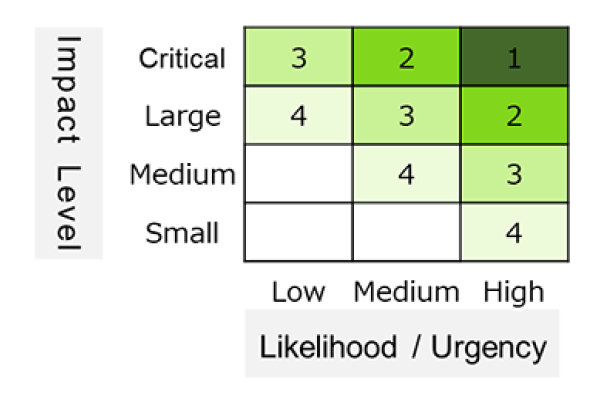
The priority of each identified nature-related risk is qualitatively and quantitatively evaluated and classified on a four-level scale from 1 (highest priority) to 4, based on a risk matrix that combines two axes: "impact" and "likelihood/urgency." Areas with blank spaces in the matrix (e.g., impact is "medium" or "small" and likelihood is "low") indicate that the impact on business operations and the natural environment is currently considered to be extremely minor.
*4 Please check the link below for details on the specific actions to be taken.
Identifying priority areas
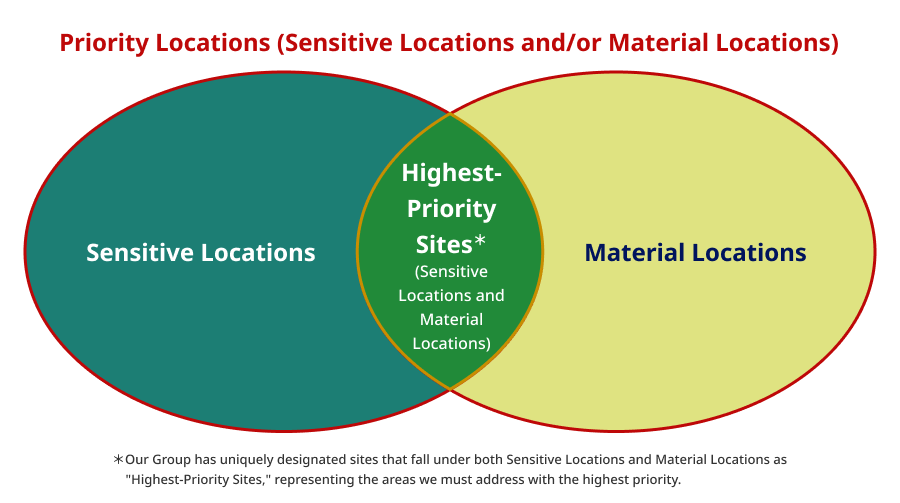
Based on the evaluation process recommended by the TNFD recommendations, our group identified locations subject to evaluation related to nature as "Sensitive Locations" and "Material Locations," and designated areas that fall under either or both of these categories as "Priority Locations." For Sensitive Locations, we identified sites requiring careful management from a natural environment perspective, based on the four perspectives indicated by the TNFD ("Importance of Biodiversity," "Ecosystem Integrity," "Importance of Ecosystem Service Supply," and "Physical Water Risk"), utilizing international databases such as IBAT and WRI Aqueduct. For Material Locations, we evaluated and identified sites based on the business continuity, production importance, and environmental impact of the processes for each site. From among these "Priority Locations," in order to quickly move to the detailed evaluation (Evaluate phase), we identified areas where the requirements for Sensitive Locations (natural environmental risk) and Material Locations (business importance) overlap as "Top Priority Locations" (a total of 6 sites) that our group should address with the highest priority.
* For detailed information on the metrics used, databases employed, and other processes, please refer to Appendix ②.
Identified top priority locations
| Country | Country | Reason for selection |
|---|---|---|
| Satsuma plant, SparkTec WKS CO., LTD. | Japan | It is one of the main spark plug factories and is located in an area where biodiversity is of high importance and ecosystem integrity is highly valued. |
| Niterra do Brasil Ltda. | Brazil | It is one of the main spark plug factories and is relevant to multiple risk indicators of the importance of biodiversity, ecosystem integrity, and the physical risks to water. |
| Siam Niterra Co., Ltd., Niterra Thailand Co., Ltd., Niterra Asia Co., Ltd. | Thailand | The process involves high water usage, posing a significant physical risk to the local water supply. |
| PT Niterra Mobility Indonesia | Indonesia |
Detailed assessment of top priority locations and future actions
For these identified priority locations, we are progressively conducting more detailed assessments to increase the resolution of nature-related risks and opportunities and to implement more effective countermeasures.
The results of the detailed nature-related dependency and impact assessment conducted earlier at the Satsuma Plant, and the specific risk mitigation measures based on those assessments, are disclosed in detail in Appendix 3. Going forward, we will proceed with similar detailed assessments in stages at our sites in Brazil, Thailand, and Indonesia.
Risk and Impact Management
Identification and evaluation process for nature-related issues
Our group is conducting analysis and evaluation based on the "LEAP approach" (Locate, Evaluate, Assess, Prepare) recommended by the TNFD recommendations, in order to appropriately understand our dependence on and impact of nature-related factors, as well as the associated risks and opportunities.
As practical steps, we have defined the following five "implementation processes" and are implementing a systematic approach.
① Understanding the overall picture (scoping, screening of dependencies and impacts)
We defined the scope of our group's business model and value chain, and conducted an initial screening of our connections with nature, as well as our dependencies and impacts.
② Identification of priority areas (selection of top priority locations)
By aligning areas requiring careful management from an environmental perspective (such as those with significant natural resources or physical water risks) with the importance of our group's business operations, we identified the locations that should be prioritized (see "Strategy" and Appendix 2 for details).
③ Identifying significant risks (measuring and prioritizing risks and opportunities)
Focusing on the identified priority locations, we identified potential risks and opportunities for our group's business activities in response to natural degradation and strengthening domestic and international regulations, and assessed their importance (see "Scenario Analysis" for details).
④ Investigation and detailed evaluation of priority locations (strategy and resource allocation plan)
To increase the resolution of location-specific dependencies and impacts for identified critical risks, we have developed a roadmap for detailed assessments (detailed investigations based on the LEAP approach) and are promoting phased, in-depth investigations.
⑤ Disclosure (reporting and publication)
Through this report, we transparently disclose to our stakeholders the insights gained through this series of evaluation processes, the identified risks and opportunities, and our group's resilience (countermeasures).
Management process for Nature-Related Issues
The Central Environment Committee will set targets and KPIs, and manage performance, for the significant nature-related risks and impacts identified through the above process.
Integration of natural-related risks into company-wide risk management.
Our group operates globally in many sectors, and each business presents various risks and opportunities. Therefore, we identify and address the risks and opportunities for each business individually. Regarding environmental risks and opportunities, including biodiversity conservation, we closely monitor regulatory trends and assess their impact on our business, and then take appropriate action.
The Risk Management Committee analyzes and evaluates risks from a company-wide perspective, determining whether they have a significant impact on business continuity and goal achievement, by examining their impact, likelihood of occurrence, and the status of countermeasures. Risks deemed to require focused attention are designated as "priority risks," with a responsible department assigned to each, and the Risk Management Committee monitors the progress of mitigation activities. Risks related to ESG, including the environment and human rights, are also evaluated, and biodiversity-related risks will be considered in the future. On the other hand, important opportunities are identified by the Sustainability Committee and reflected in management strategies and priority management issues as needed.
Metrics and targets
Our group uses quantitative and qualitative indicators for monitoring and target setting to assess and manage our dependence on and impact of nature-related factors, as well as risks and opportunities. In this disclosure, we will disclose our performance along two axes: the "Global Core Indicators" recommended by the TNFD and the achievement targets set forth in our group's "Eco Vision 2030."
Disclosure of performance data based on TNFD global core metrics
To accurately understand the environmental impact of our group's business activities, we collect environmental performance data at 9 domestic companies and 21 overseas companies (60 locations in total), including our headquarters and sales offices. Our group's response to and disclosure status regarding the TNFD's global core indicators is as follows:
| Measurement index number | Factors in natural change | Index | Measuring index | 2024 data |
|---|---|---|---|---|
| - | Climate Change | GHG emissions | *Refer to ISSB's IFRS S2 "Climate-related Disclosures". | Disclosure separately (Climate Change Sector) |
| C1.0 | Changes in the use of land, freshwater, and ocean | Total spatial footprint | ● Total spatial footprint | Disclosure in the future |
| C1.1 | Scope of changes in land/freshwater/ocean use | ● Scale of changes in land, freshwater, and ocean use (km²) ● Area (km²) of conserved or restored land, freshwater, and marine areas ● Area (km²) of land, freshwater, and ocean areas managed through interconnected systems. |
Not applicable | |
| C2.0 | Pollution/Decontamination | Total amount of pollutants released into the soil by type | ●Total amount (t) of each type of pollutant released into the soil | Not applicable |
| C2.1 | Drainage amount | ● Discharge volume (total volume, freshwater, other) | ●Total volume: 1,542,000 m³ (by discharge destination) - Freshwater surface water: 1,255,000 m³ - Third-party discharge site: 287,000 m³ |
|
| C2.2 | Waste generation and disposal | ●Weight of generated waste and hazardous waste (by type) (t) ● The amount of waste and hazardous waste classified as follows: - Items that were incinerated. - Reclaimed land - Others ● Amount converted from landfill -Reuse -Recycling - Other recovery methods |
●Total amount of waste: 20,332 tons (breakdown) - Incineration: 609 tons - Landfill disposal 1248 t -Recycle 16718 t ●Total amount of hazardous waste (Japan): 609 t (breakdown) - Incineration disposal 2 ton - Landfill disposal 59 t -Recycle 549 t |
|
| Plastic pollution | ●Weight (tons) of plastics used or sold (by raw material) ● Percentage of plastic containers that are reusable/compostable/technically recyclable/practically recyclable on a large scale (%) |
Not applicable | ||
| C2.3 | ||||
| C2.4 | Total amount of air pollutants other than GHGs | ●Total amount (t) of non-GHG air pollutants by type PM, NOx, VOCs, SOx, Ammonia |
Disclosure in the future | |
| C3.0 | Resource use/recovery | Water intake and consumption from water-scarce regions | ●Total water intake and consumption (m³) from water-depleted areas | Total water intake: 239,561 m³ |
| C3.1 | The quantity of high-risk natural primary products sourced from land/sea/freshwater | ●Quantity (t) of high-risk natural commodities sourced from land, sea, and freshwater sources, by type. ● The amount (t) of high-risk natural commodities sourced under a sustainable management plan or certification program. |
Disclosure in the future | |
| C4.0 | Invasive alien species, etc. | Placeholder indicators: Measures against the unintentional introduction of invasive alien species (IAS) | ● The percentage of high-risk activities that employ appropriate methods to prevent the accidental introduction of invasive alien species, or the percentage of activities that were classified as low-risk. | ― |
| C5.0 | Natural state | Placeholder indicators: Ecosystem status | *Organizations that choose to disclose indicators related to the natural state are recommended to use the following indicators. • Ecosystem status level by ecosystem type and business type • Risk of species extinction |
― |
| Placeholder indicator: risk of species extinction |
Disclosure of management indicators and performance data in EcoVision 2030
Our group has formulated "Eco Vision 2030," a medium- to long-term environmental target, to realize a sustainable society. Focusing on the following four key issues, which are deeply related to nature-related challenges, we have set our desired state (target) for 2030 and are promoting our efforts. We have set quantitative targets for responding to climate change, conserving water resources, and managing waste, and we are monitoring the progress toward them.
| Our vision for 2040 |
The milestone to be achieved in 2030 |
Targets for fiscal year 2024 | 2024 results | |
|---|---|---|---|---|
| Response to Climate Change | Implementing activities toward realization of a decarbonized society. * Achieving carbon neutrality by 2050 |
CO₂ emissions Compared to fiscal year 2018 • Scope 1 & 2 reduced by 46% • Scope 3 reduction by 30% |
CO₂ emissions Compared to fiscal year 2018 • Scope 1 & 2 reduced by 10% • Scope 3 — |
CO₂ emissions Compared to fiscal year 2018 • Scope 1 & 2 reduction of 31.7% • Scope 3 reduction of 13.4% |
| Conservation of Water Resources | Implementing sustainable business operations in response to global water risks | Maintain water usage intensity at or below 2018 levels. | 54,000 m³/million yen | 39,100 m³/million yen |
| Management of Waste | Contribute to a global recycle-oriented society by promoting zero emission | • Effective utilization rate of over 95% • Compared to FY2018, the annual reduction in unit consumption was more than 1%. |
• Effective utilization rate - • Unit cost: 0.075 t/million yen |
• Effective utilization rate: 90.6% • Unit cost: 0.051 t/million yen |
Future prospects
Going forward, we will conduct a detailed assessment of nature-related risks and opportunities at our identified priority locations (Satsuma, Brazil, three companies in Thailand, and Indonesia) through an in-depth investigation based on the LEAP approach. We will then further consider how to define indicators and targets for more precise management of our group's significant nature-related dependencies, impacts, risks, and opportunities.