



Management of Waste
Basic Philosophy
Earth's resources are limited, and sustainable use and conservation are essential. As a manufacturing company, our group uses a variety of raw materials, including ceramics and precious metals, and we believe it is our responsibility to actively engage in reduce, reuse, and recycle (3R) to protect the global environment. In our Eco Vision 2030, our group has set forth the goal of "promoting zero emissions and contributing to the formation of a global circular economy" as its target state for 2040, and has set targets of "effective utilization rate of 95% or more," "reduction of emissions intensity by more than 1% per year compared to FY2018," and "promotion of 3R activities" as our desired state for 2030.
Furthermore, we will promote the sustainable and efficient use of raw materials and other resources within our supply chain.
Trends in waste generation intensity
In EcoVision 2030, we set a target of "reducing waste emission intensity by more than 1% annually compared to FY2018" as our desired state in 2030. In FY2025, the group's waste emission intensity was 0.057 tons/million yen, a 24.4% reduction compared to FY2018, achieving our target. We will continue to improve our processes and work towards reducing waste.
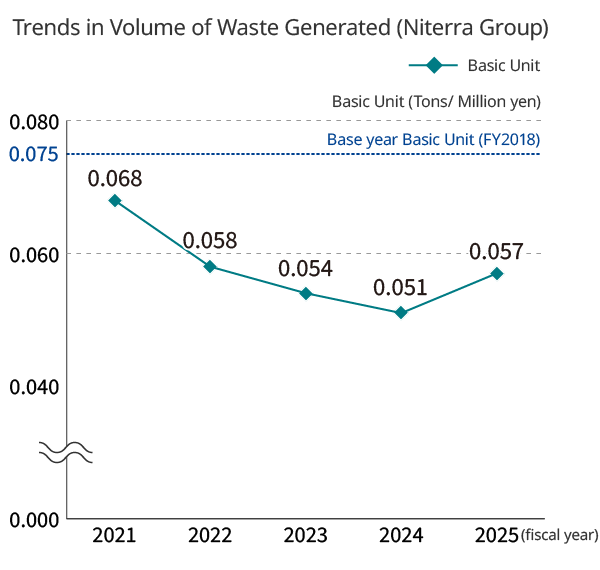
(This includes NTK Cutting Tools, Kamioka Ceramics, and NTK Ceramics Korea until fiscal year 2022. It includes Nittoku Electronics until fiscal year 2023. It includes Hiyori Kiki and NTK Medical until fiscal year 2024.)
Trends in the effective utilization rate of waste
In our Eco-Vision 2030, our group has set a target of "effective utilization rate of 95% or higher" as our desired state for 2030. In fiscal year 2025, the group-wide effective utilization rate was 96.0%, an improvement from fiscal year 2024. The improvement in the effective utilization rate, achieved through progress in the effective use of resources overseas, has allowed us to reach our Eco-Vision target. We will continue our efforts to effectively utilize waste in the future.
Reduce efforts
Initiatives during the design phase
By making the products lighter and smaller, we are reducing the amount of raw materials required.
事例:スパークプラグの小型化
薄くしても絶縁破壊しにくい高耐電圧アルミナ絶縁材料の開発により、スパークプラグを小型化し、資源の利用を抑制しています。
Initiatives in the manufacturing process
We reduce process losses by optimizing processing conditions and improving setup to increase processing accuracy and reduce defect rates.
事例:シート成形条件の最適化
セラミックシート製造工程において、原料の調合や塗工速度を最適化し、緻密な厚み管理で歪みを抑えることで、乾燥時の割れや端材を減らして工程ロスを低減しています。
Initiatives to promote a paperless environment
Our group is promoting paperless operations company-wide, across all departments, and is striving to reduce paper usage.
事例:資料等の電子化
従業員向け研修資料の電子化に加え、ステークホルダーの皆さまのご協力のもと、契約書の電子締結や、統合報告書、サステナビリティ調達ガイドラインなどのオンライン配布を実施しています。
Reuse Initiatives
Repair and reuse of production equipment
We maintain our production equipment in-house and use it for extended periods. Even equipment that has reached the end of its original role is reused and put to good use within the company. Furthermore, we repurpose equipment beyond the scope of our business to adapt to changes in production volume driven by market needs.
事例:冷間鍛造機の再利用
海外で使用しなくなった冷間鍛造機を修繕し、日本で再利用しています。
事例:設備の転用
半導体事業で利用していた設備をセンサ事業用に改良し、転用しています。
Standardization of production equipment
We standardize equipment specifications as much as possible and develop equipment that can be used across different businesses. This allows for the reuse of parts such as the base and control panels of the equipment in different processes.
事例:共通化仕様の設備の導入
産業用セラミック部品の製造工程の一部において、将来的な工程変更の計画のもと、共通化仕様の設備を導入しています。
Recycling efforts
Promoting material recycling
Our group is promoting material recycling in order to make effective use of limited resources. Furthermore, from the perspective of reducing CO2 emissions, we are advancing the shift from thermal recycling to material recycling of waste materials.
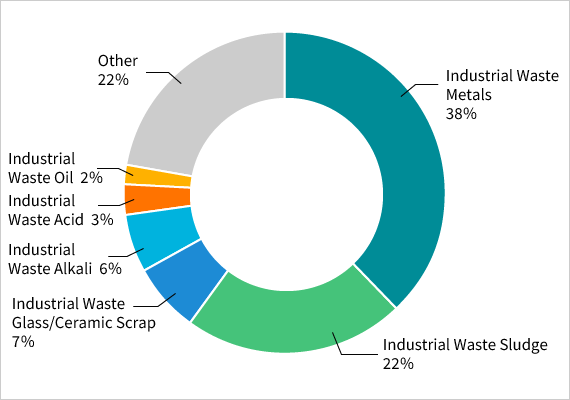
Main waste recycling methods
| Types of waste | Recycling methods |
|---|---|
| Metals | It is refined and recycled as raw material of the same quality. |
| Sludge (Mainly ceramic raw materials before firing) |
It is recycled as a raw material for ceramics and as recycled embankment material. |
| Glass and ceramic waste (Ceramic powder and sheet scraps before firing, ceramic scraps after firing) |
The powder is recycled as a ceramic material if it has high purity, and as a cement raw material if it does not. The ceramic waste is recycled as roadbed material. |
| Waste oil | The fuel is recycled through processes such as distillation. |
| Plastic | Recycled as plastic material. It is recycled by being converted into RPF (solid fuel). |
Initiatives under the "Act on Promotion of Resource Recycling Related to Plastics"
As part of our efforts related to the "Act on Promotion of Resource Recycling Related to Plastics," our group is reusing plastic packaging materials and recycling waste plastics.
Regarding plastic packaging materials, we reuse the packaging materials used for delivered parts in other departments. The departments that received the packaging materials have seen a decrease in new purchases of packaging materials.
Material recycling of waste plastics is an initiative to switch from thermal recycling of waste plastics to material recycling. In our group's ceramic sheet manufacturing process, a large amount of mixed waste of ceramics and plastics is generated. This waste is unavoidable due to the nature of the manufacturing process, and until now we have been working to reduce the amount of waste generated as much as possible through process improvements. From fiscal year 2021, we have been seriously promoting material recycling, and by fiscal year 2024 we were able to material recycle all of this mixed waste, and we are continuing to operate under this system.
Furthermore, we are working to make the expanded polystyrene, which was previously thermally recycled, valuable by converting it into ingots using volume reduction machines.
We will continue to promote initiatives for the recycling of plastic resources.
Effective use of food waste
At our company, we implement awareness campaigns and initiatives to reduce food waste in our employee cafeterias, but some food waste is still generated. Food waste from the employee cafeteria at our Komaki factory is transported to a biogas power plant in Komaki City, where it is converted into biogas through methane fermentation and effectively used as fuel for power generation.
Proper disposal of waste
We regularly inspect waste disposal companies to ensure that waste is being processed according to contract. In fiscal year 2024, we inspected 32 locations and confirmed that waste was being processed properly.
Initiatives for resource recycling throughout the product lifecycle
Our group efficiently utilizes resources throughout the entire product lifecycle.
Extending the lifespan of products
By providing highly durable and high-strength products, we reduce the frequency of replacements during use.
事例:貴金属(イリジウム合金)プラグの提供
交換部品であるスパークプラグの電極部分をイリジウム合金にすることで性能向上と長寿命を両立しています。
Product repair and restoration
We offer a service to repair parts whose performance has deteriorated due to use, making them usable again.
事例:静電チャックのリファブサービス
半導体製造装置の重要部品である静電チャックにおいて、摩耗・劣化した表面を精密に修復し、再利用を可能にしています。
Product collection and recycling
We view used products as valuable resources and are working to collect and reuse them.
事例:北米での酸素センサ回収
北米市場において、役目を終えた使用済みの酸素センサを回収し、リサイクルしています。