



Information Disclosure Based on TCFD Recommendations
In July 2020, our group expressed its support for the recommendations of the TCFD (Task Force on Climate-related Financial Disclosures).
In accordance with the TCFD recommendations, we disclose the following important information regarding climate change.
Governance
Our group recognizes environmental issues, including climate change, as important management challenges. Therefore, the Board of Directors will make the final decisions and oversee all aspects of our response to climate change.
Regarding management policies and directions concerning climate change, the Sustainability Committee * (chaired by an outside director and meeting at least four times a year), which is an advisory body to the Board of Directors, compiles recommendations based on climate-related risks and opportunities, submits them to the Board of Directors, and the Board makes the final decision.
Furthermore, progress on key management issues, including "responding to climate change," is reported from the Sustainability Department to the Sustainability Committee, which reviews and monitors the progress. Specific activities such as CO2 emission reductions are monitored by the Environment Committee (held twice a year) to track progress towards targets, identify challenges, and ensure continuous improvement. Climate change risks are assessed within the framework of integrated risk management by the Risk Management Committee (held twice a year).
Important decisions made by each expert committee are reported to the Board of Directors through the Management Meeting, which deliberates, decides on, and supervises important matters in business execution, and are then overseen by the Board of Directors.
* In June 2022, we transitioned to a company with an Audit and Supervisory Committee, and positioned the Sustainability Committee as an advisory body to the Board of Directors.
- Corporate Governance System
- Sustainability Promotion System
- Risk Management Promotion System
- Environmental Management Promotion System
Examples of discussions and decisions made regarding climate change to date
- Approval of the priority management issue "30% reduction in CO2 emissions [compared to FY2018] (FY2030)" (CSR & Sustainability Committee, March 2020)
- Statement of support for the TCFD recommendations (Management meeting, July 2020)
- Approval of "Eco Vision 2030" (Environment Committee, March 2021)
- Approval of the goal to "aim for carbon neutrality by 2050" (CSR & Sustainability Committee, March 2021)
- Approval of "CO2 emissions: 71.4% reduction [compared to FY2018] (FY2035)" (Environment Committee, March 2025)
- Approval of "CO2 emissions: 46% reduction [compared to FY2018] (FY2030)" (Environment Committee, March 2026)
Strategy (risks and opportunities)
Scenario analysis for climate change
Regarding climate-related risks and opportunities, we have taken a comprehensive look at the entire supply chain from upstream to downstream, predicting short-term, medium-term, and long-term social and regulatory trends, and listing a wide range of risk and opportunity items, referencing examples from the TCFD recommendations.
Then, regarding the listed risk items, we considered "risks related to the transition to a low-carbon economy" that would occur mainly during the 2°C scenario, and "risks related to physical changes due to climate change" that would occur if the global CO2 emission reduction targets were not met and the 4°C scenario was reached. We then organized these items according to the TCFD classification and evaluated their business impact. Specifically, the sustainability department held extensive discussions to identify the risk items and drafted the business impact and evaluation. In addition, regarding the listed opportunity items, we organized and examined them according to the TCFD classification as "opportunities for management reform through climate change mitigation and adaptation measures."
Furthermore, we consulted and discussed the matter with executives from the Sustainability Department, as well as with relevant departments such as the Risk Management Department and the Environment Department. The compiled risks and opportunities related to climate change were reported to and confirmed by the Sustainability Committee.
<Main scenarios and predictions used in the analysis>
2°C scenario: IPCC RCP2.6, IEA ETP 2DS, etc.
4°C scenario: IPCC RCP8.5, S&P Global's "Mobility and Energy Future" service data, etc.
The timing of the assessment (impact), risks, and opportunities mentioned here is as follows:
Evaluation (degree of impact)
Small: Impact of several hundred million yen
Middle: An impact of approximately 5 billion yen.
Large: Impact of over 10 billion yen
When risks/opportunities arise
Short term: Until around 2027
Medium term: Until around 2030, aligned with the target year of the long-term management plan.
Long term: Up to around 2040, aligned with the vision outlined in the long-term management plan.
<Climate-related risks>
| Risk items | Business impact (risk) | Evaluation (Degree of impact) |
Risk When it appears |
||
|---|---|---|---|---|---|
| Risks associated with the transition to a low-carbon economy | policy· Legal regulations |
Carton tax | • If a carbon tax is introduced, fuel procurement costs will be taxed, leading to increased energy and raw material costs. | Large | Medium to long term |
| Border carbon tax | • If a border carbon tax is introduced, exported products will be taxed, which will reduce the price competitiveness of those products. | Large | Short-term to long-term | ||
| Carbon emission regulations | • Achieving GHG reduction targets will increase costs associated with capital investment and the purchase of renewable energy. | Large | Medium to long term | ||
| Gasoline car sales | • In countries that ban the sale of new gasoline-powered vehicles, OEM demand disappears, leading to a decline in sales. | Large | Medium to long term | ||
| Technology | Widespread adoption of energy-saving and renewable energy technologies | • Introducing new energy-saving and renewable energy technologies will increase the costs associated with capital investment and other related expenses. | Medium to large | Short-term to long-term | |
| New Technology Development | • Investment costs for research and development of new technologies will increase. | Large | Short-term to long-term | ||
| Market | Customer changes | • From the 2030s onward, more people will choose ZEVs even for used cars, leading to a decrease in the demand for spark plug replacements and a decline in sales. • Products with lower CO₂ emissions throughout their lifecycle are being chosen, leading to a decrease in sales of conventional products. |
Large | Long term | |
| Reputation | Changes in Investors | • Internal combustion engines face increasing pressure and become targets for divestment. | Small to middle school | Medium to long term | |
| Changes in Job Seekers | • Internal combustion engines face increasing criticism and are no longer chosen as a source of employment. | Small to middle school | Short to medium term | ||
| Risks related to physical changes caused by climate change | Acute | Intensification of extreme weather events | • Typhoons and other natural disasters can cause damage to factories and other facilities, leading to operational shutdowns and reduced production. Additional costs will also be incurred for equipment repairs. Insurance premiums will also increase. | Small to middle school | Short-term to long-term |
| Chronic | Rising sea levels | • Rising sea levels will increase floods and storm surges, damaging coastal factories and transportation infrastructure, disrupting supply chains, and incurring response costs. | Small to middle school | Long term | |
| Changes in precipitation and weather patterns | • Factories located in areas with severe water shortages may face restrictions on water use, forcing them to suspend or reduce operations, resulting in additional costs for production at other factories or transportation. | Small to middle school | Long term | ||
| Rising average temperature | • Heatstroke cases become frequent among employees working in extreme heat, increasing their physical strain and leading to increased costs and labor expenses for heat countermeasures. | Small to middle school | Long term | ||
Furthermore, we conducted a risk potential survey of our main business locations regarding current flood, drought, and storm surge risks. Considering the expected extent and frequency of damage, we found that the likelihood of serious damage occurring is low.
Meanwhile, a risk potential survey for future floods, droughts, and storm surges revealed that there are areas where rainfall is expected to increase. However, whether or not this directly leads to an increase in the risk of floods and landslides depends on the location of each project site (ground conditions, elevation, distance from rivers, etc.) and the status of flood control measures, so we will continue our investigations.
<Climate-related opportunities>
| Side | Main opportunities | Timing of the impact |
|---|---|---|
| Resource efficiency | ・The introduction of new energy-saving and renewable energy technologies within the company will progress, leading to a decrease in energy costs. | Medium to long term |
| Energy source | ・Demand for hydrogen as a fuel exempt from carbon taxes is increasing, creating new opportunities in the hydrogen energy market. As technologies such as methanation develop and synthetic fuels such as eFuel become widespread, the current internal combustion engine business will continue. |
Long term |
| Products/Services | ・Demand for high value-added products will increase in order to comply with fuel efficiency regulations. | Short to medium term |
| ・The mandatory reduction of GHG emissions is expected to expand the hydrogen energy market, leading to increased demand for hydrogen-related technologies, SOFCs, and SOECs, and creating business opportunities. | Long term | |
| ・Demand is increasing for CO₂ recycling-related solutions, such as producing hydrogen using electricity (SOEC) and using captured CO₂ as fuel. | Long term | |
| ・In preparation for disasters, local energy production and consumption (decentralized power generation) is attracting attention, and the demand for SOFCs is increasing. | Long term | |
| ・Demand for ceramic-related technologies and products used in electric motors and generators is increasing. | Medium to long term | |
| Market | ・Developing new climate change-related technologies that address societal needs creates business opportunities. | Medium to long term |
| Resilience | ・By continuously strengthening BCM/BCP, including the supply chain, in preparation for disasters, resilience will be enhanced. | Short-term to long-term |
Business risks, opportunities, and responses based on climate-related scenarios
To more concretely identify the risks and opportunities of climate change, we examined the business environment and responses under 2°C and 4°C scenarios for each project. As a result, we found no fatal impacts in terms of physical risks.
Regarding our business, our internal combustion engine business, which currently accounts for 80% of our sales revenue, is facing a major transformation. On the other hand, new needs and markets are expected, particularly in the area of hydrogen, as we move towards realizing a decarbonized society. Therefore, in our "Long-Term Management Plan 2030," we have designated "Environment and Energy" as one of the business areas we will focus on going forward, and we are promoting the optimization of our business portfolio toward 2040.
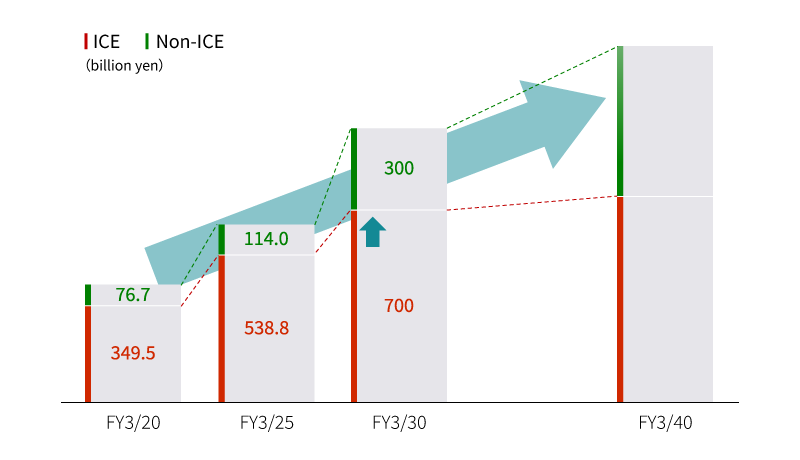
| Businesses under consideration | Product | Responding to future business risks and opportunities | Financial impact | Sales revenue targets in the long-term business plan |
|---|---|---|---|---|
| Automotive components | Spark plugs, glow plugs, sensors | Under a 2°C scenario, stricter regulations on vehicles with internal combustion engines are expected to lead to a decline in sales of internal combustion engine components in the future. On the other hand, opportunities will arise in new markets such as the electric vehicle market. Under a 4°C scenario, further energy savings and reductions in harmful gas emissions from internal combustion engines are required, so we will address this by improving performance. |
Impact on a portion of sales revenue *1 | 700 billion yen (FY2029) |
| Fuel cell business | Fuel cells | Under both the 2°C and 4°C scenarios, demand for non-fossil energy is expected to increase, so we will continue to strengthen our response to this market. Under a 2°C scenario, the widespread adoption of hydrogen infrastructure is expected, potentially leading to accelerated market growth. |
A market of 200 billion yen is expected, with the possibility of exceeding this depending on the spread of hydrogen infrastructure. | 300 billion yen (FY2029) |
| Other businesses | SPE, packages, oxygen concentrators, bearing balls, etc. | In both the 2°C and 4°C scenarios, the impact on risks and opportunities is small. | Small |
- Under a 2°C scenario, the automotive-related business is expected to see a decline in future sales due to stricter regulations, making a shift in the business portfolio necessary.
- Regarding our other businesses, we closely monitor market trends under both the 2°C and 4°C scenarios, and conduct our business flexibly and strategically, demonstrating high resilience from a medium- to long-term perspective.
*1 Regarding the financial impact of the internal combustion engine business.
Based on our analysis by S&P Global, we forecast that the number of vehicles equipped with internal combustion engines will decline from the mid-2030s onward due to increasing regulations on internal combustion engines resulting from climate change measures in various countries. On the other hand, spark plugs, which are the core of our internal combustion engine business, have demand not only for new vehicles but also for replacements, and we forecast that vehicles equipped with internal combustion engines will continue to be in operation. Therefore, we expect sales to peak after 2040 and then gradually decline. Taking these circumstances into account, if we assume that sales revenue from the internal combustion engine business will decrease by 5% from 2024 to 2040, the decrease in sales revenue will be approximately 27 billion yen, and the decrease in operating profit will be approximately 7 billion yen.
Sales revenue for the internal combustion engine business in fiscal year 2024: 538.9 billion yen
Operating profit for the internal combustion engine business in fiscal year 2024: 140.9 billion yen
Assumed percentage decline in sales of internal combustion engine products from fiscal year 2040 onwards: 5%
Sales revenue: 538.9 billion yen x 5% = 26.9 billion yen
Operating profit: 140.9 billion yen x 5% = 7 billion yen
Risk Management
Our group operates globally in many sectors, and each business presents various risks and opportunities. Therefore, we identify and address the risks and opportunities for each business individually. Regarding climate change risks and opportunities, we closely monitor regulatory trends and other factors, assess their impact on our businesses, and take appropriate measures.
The Risk Management Committee analyzes and evaluates risks from a company-wide perspective, determining whether they have a significant impact on business continuity and goal achievement, by examining their impact, likelihood of occurrence, and the status of countermeasures. Risks deemed to require focused attention are designated as "priority risks," with a responsible department assigned to each, and the Risk Management Committee monitors the progress of mitigation activities. Risks related to ESG, including climate change and human rights, are also evaluated. Meanwhile, significant opportunities are identified by the Sustainability Committee and reflected in management strategies and priority management issues as needed.
Indicators and targets
Our group has designated "solving social issues" as a priority management issue, and as a main initiative, we have set a long-term goal of carbon neutrality by 2050, and as intermediate targets, we have set targets of "reducing CO2 emissions by 46% (compared to 2018)" by 2030 and "reducing CO2 emissions by 71.4% (compared to 2018)" by 2035. Furthermore, in order to achieve these targets, we are planning and promoting specific measures in "Eco Vision 2030".
EcoVision 2030 identifies four key challenges: addressing climate change, expanding environmentally friendly products, conserving water resources, and managing waste. Expanding environmentally friendly products aims to provide products and services that contribute to addressing climate change and reducing CO2 emissions, such as solid oxide fuel cells (SOFCs) and carbon neutrality as a service. Furthermore, conserving water resources and reducing resource input and waste generation will lead to a reduction in CO2 emissions. Therefore, these have been set as four key challenges, and rather than addressing them individually, the aim is to address them as interconnected issues to achieve a more synergistic response.
Furthermore, in order to promote CO2 reduction efforts as a group, we have introduced ICP (Internal Carbon Pricing). We collect 10,000 yen from each ton of CO2 emissions from the emitting departments, and the collected amount is used as an internal environmental fund to support investments and infrastructure development for decarbonization.
Regarding Scope 1 and 2 emissions, CO2 emission reduction measures such as energy conservation activities progressed as planned, and as a result of accelerating the adoption of energy generation through solar power and CO2-free electricity, reductions exceeded the planned values.
At the same time, we are also promoting reductions in Scope 3 emissions, including in the supply chain. Scope 3 emissions, specifically Category 1 "Purchased Products and Services," Category 4 "Transportation and Delivery (Upstream)," and Category 11 "Use of Products Sold," account for 97.6% of the total Scope 3 emissions. Therefore, we have set a target of a 30% reduction in these three categories by FY2030 (compared to FY2018). We are asking our business partners (suppliers) to set and work towards CO2 reduction targets, and we are providing support as needed through carbon neutrality seminars and CO2 reduction support programs (Category 1). We are also focusing on activities aimed at reducing CO2 emissions throughout the entire supply chain, such as changing product delivery routes and transportation methods (Category 4) and implementing environmentally conscious design (Category 11).
<CO2 Reduction Targets and Results>
| Item | Target | Achievements |
|---|---|---|
| Scope 1 & 2 | 46% reduction by fiscal year 2030*1 71.4% reduction by FY2035*2 (Compared to fiscal year 2018) |
31.9% reduction by fiscal year 2025 (Compared to fiscal year 2018) <Emissions: 203,000 tons> <Unit cost: 0.45 tons/million yen> |
| Scope 3: Category 1: "Purchased Products and Services" Part of Category 4 "Transportation and Delivery (Upstream)" Category 11: "Use of products sold" |
30% reduction by fiscal year 2030 (Compared to fiscal year 2018) |
FY2025 8.5% decrease (Compared to fiscal year 2018) <Emissions: 10.33 million tons> |
*2. The new targets for FY2035 and FY2030 are our own milestones formulated with the aim of achieving the SBTi 1.5°C standard.